


- Yes: a few forces still use crossbows, mostly special units in China, Greece, Turkey, Spain and Serbia.
- Their value is quiet, flash-free shots and launching lines, not replacing rifles.
- China’s Snow Leopard Commando Unit is reported to use them to stop people carrying explosives without setting them off.
- In the US, a crossbow-launched grapnel hook exists for clearing tripwires, but crossbows aren’t standard issue.
- Outside the military, crossbows serve hunters, target shooters and whale researchers.
A soldier with a crossbow, in this century? It sounds like a movie prop, but it’s real. 😮
The work is narrow: quiet shots, launching lines and training, never a rifle replacement. As a Marine infantry veteran (2010 to 2014, Afghanistan), I find this one fascinating, so you’ll get the documented uses, from the medieval arbalest to modern special operations.
Does any military use crossbows today? Yes, in a few niche roles
No modern army issues crossbows to regular troops. The documented uses are small, specialized and mostly special forces, and much of the reporting comes from secondary sources such as Wikipedia’s crossbow article and press photos.
- China: the Snow Leopard Commando Unit of the People’s Armed Police and the People’s Liberation Army are reported to use crossbows, partly to stop people carrying explosives without risking a detonation.
- Greece and Turkey: special forces in both countries are reported to keep crossbows.
- Spain: the army’s special forces, known as the Green Berets, are reported to still use the crossbow.
- Serbia: The Guardian reported that Barnett crossbows sold to Serbian forces were used in ambushes and as a counter-sniper weapon in the Kosovo War, and a Serbian defence minister was photographed testing one in 2008.
- Peru and Brazil: a photo shows Peruvian soldiers with crossbows and rope rigging a zip-line, and Brazil’s Jungle Warfare Training Center (CIGS) is reported to train soldiers with crossbows.
- United States: SAA International has made a crossbow-launched version of the US Army’s Launched Grapnel Hook, a tool that snags tripwires to clear mines.
So the answer is yes, but with a small footprint. Crossbows fill gaps that rifles leave: shots without a muzzle flash, lines across gaps, and situations where a gunshot or explosion would be worse than the problem.

// Free printable
Get the range log I actually use.
Seventeen printable pages: session log, score tracker, a 30-day drill challenge, a bow maintenance card, a first-season checklist and more. Join the monthly email and it lands right away.
History of crossbows in warfare: from ancient China to medieval Europe
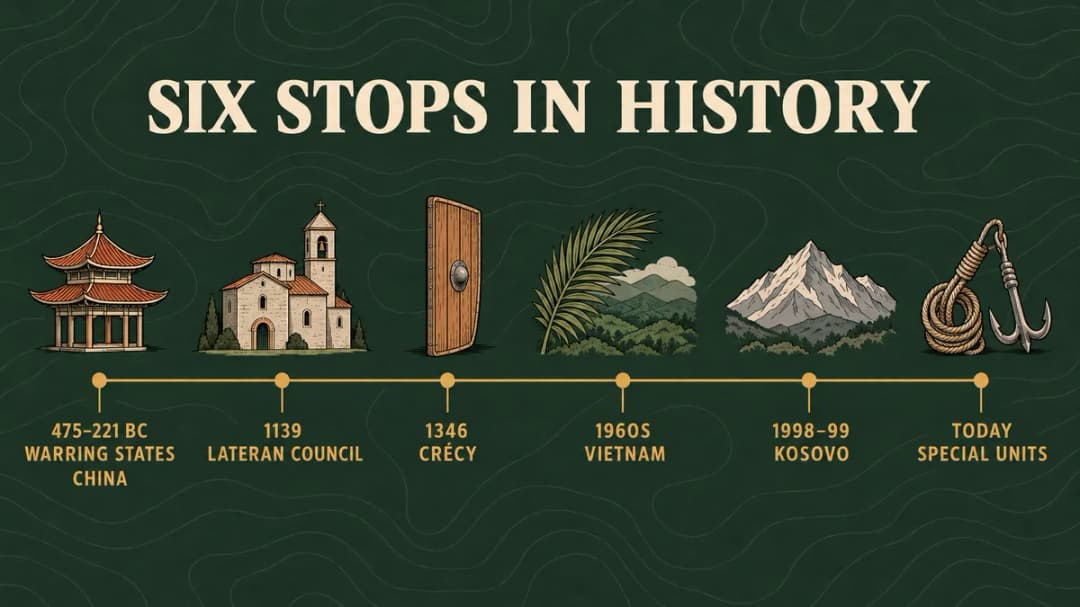
The crossbow is one of the oldest mechanical weapons. Bronze crossbow triggers from China date to around the 6th–5th century BC, and crossbows were a main weapon of the Warring States period (475–221 BC).
In the Greek world the gastraphetes, or “belly bow,” appeared around the late 5th or 4th century BC. Medieval Europe made the crossbow a battlefield staple, and the heavy steel-prod arbalest came later still.
Crossbows worried the church enough that the Second Lateran Council of 1139 condemned crossbowmen and archers who fought against Christians. At Crécy in 1346, Genoese crossbowmen fought without their pavises, the big sheilds they reloaded behind, which had been left with the baggage.
Crossbows in the Vietnam War and modern special operations
The Montagnard peoples of Vietnam’s Central Highlands hunted and fought with traditional crossbows. US Special Forces worked closely with Montagnard fighters from the early 1960s, starting with village defense groups such as the one at Buon Enao.
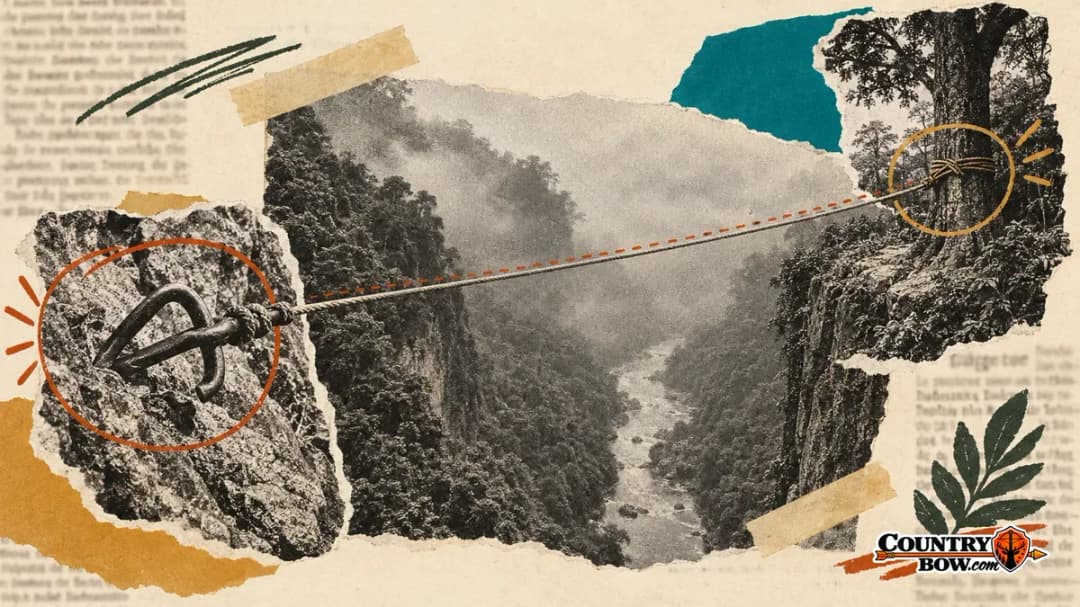
Today the modern uses are tools more than weapons. The crossbow-launched grapnel hook throws a hook and line over an area to snag tripwires and crossbows can carry a line across a river or ravine for a zip-line.
Modern crossbows are also lighter and more compact than older designs. A compact reverse-draw or compound crossbow is far easier to carry than a medieval one; see the types of crossbows for how they differ.
Task & Purpose, a defense channel, looks at which forces still use crossbows today, from China to Brazil’s jungle school, and it’s openly skeptical of some of the reasons given. That makes it the most honest video I’ve found on the subject.
Before it gets into the reasons, the video makes the point this whole post comes back to:
Crossbows are not standard equipment for the Chinese military and police forces. According to Chinese sources, most of the crossbows are purchased by the units themselves.
That’s the right frame for every headline about “crossbow commandos”. Crossbows are niche tools a few units choose, not a standard weapon, even in the country most linked to them.
Why militaries still use crossbows: advantages and disadvantages
A crossbow isn’t silent, but it’s far quieter than a rifle and has no muzzle flash. That’s the core of its military appeal.
Task & Purpose makes the same point about noise in its video (in the section above):
Crossbows are quieter. There’s a misconception that they’re totally silent, but that’s not the case. They are quiet, but they do make noise, it’s just way less than an unsuppressed firearm.
Hunters learn the same lesson in the woods. Quiet isn’t silent: a deer can still hear the shot and start to move before the bolt arrives.
Pros
- Much quieter than firearms, with no muzzle flash
- No explosive propellant, which matters around explosives
- Can launch lines, hooks and grapnels
- The string stays locked back, so the shooter can aim without holding a draw
Cons
- One shot, then a slow reload
- Shorter effective range than rifles
- Extra bolts and parts that standard supply chains don’t carry
- Bulkier than a pistol or carbine
Here’s how crossbow use has changed over time. Each row is a documented or widely reported example.
| Era | Who | How crossbows were used |
|---|---|---|
| Warring States China (475–221 BC) | Chinese armies | Main infantry missile weapon |
| Medieval Europe | Genoese and other crossbowmen | Massed shooting from behind pavises |
| Vietnam War | Montagnard fighters alongside US Special Forces | Traditional crossbows for hunting and fighting |
| Kosovo War (1998–1999) | Serbian forces | Reported ambush and counter-sniper use |
| Today | Special units in China, Greece, Turkey, Spain; training in Brazil | Silent shots, line launching, tripwire clearing |
Non-military uses for crossbows: hunting, sport and science
Most crossbows in the world today are in the hands of hunters. Many US states allow crossbows in archery or general seasons, and a sharp broadhead is what makes them effective on game.
Crossbows are also a target sport. The IAU (International Crossbow Shooting Union) runs field and match crossbow competitions, and plenty of shooters just practice on a crossbow target at home.
Marine biologists use crossbows too. A crossbow-fired biopsy dart takes a small skin and blubber sample from a whale or dolphin, and a stopper keeps it shallow so the dart bounces off and floats.
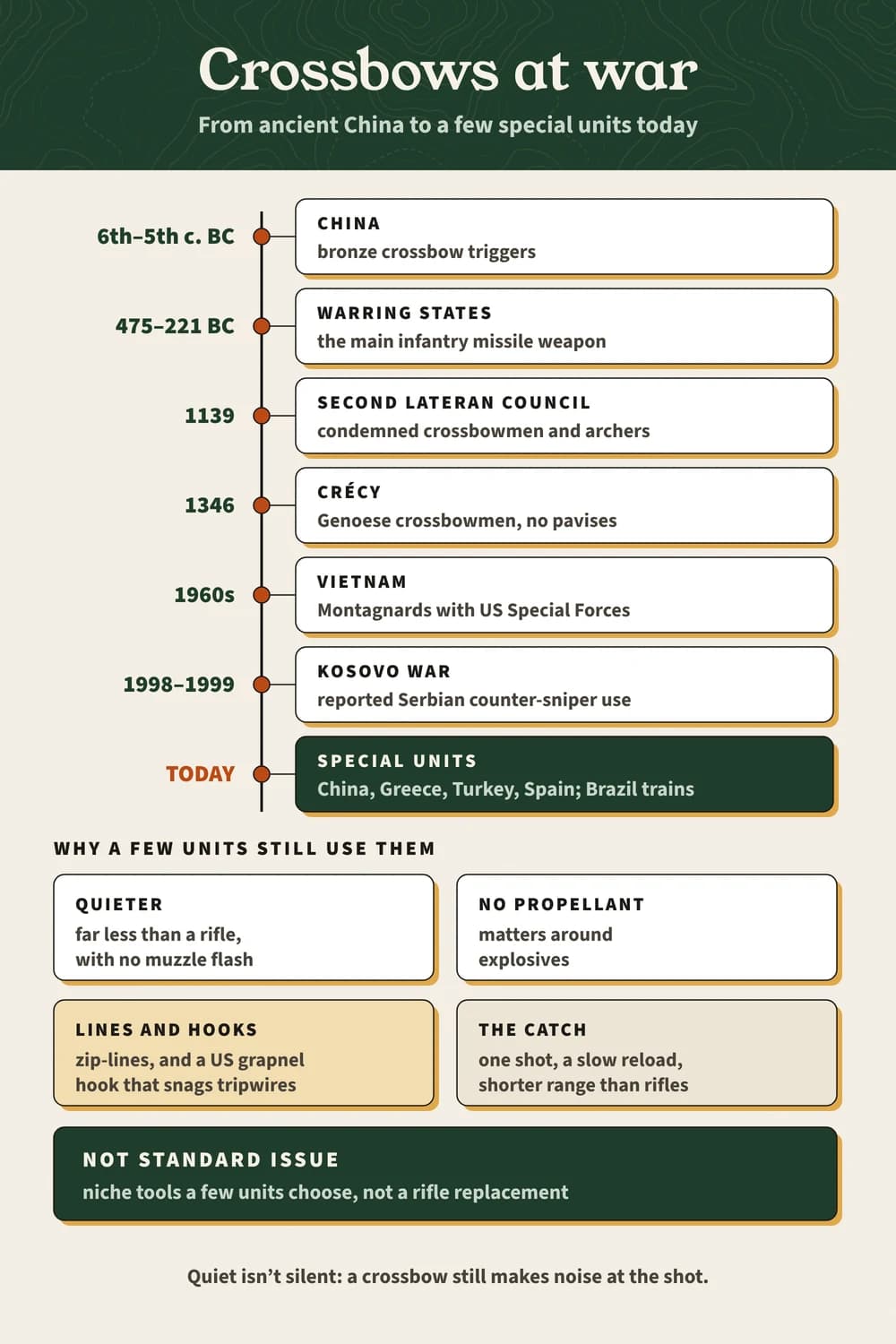
The whole story fits on one page: here it is, from bronze triggers to special forces.
// FAQ
Frequently asked questions
Quick answers to the questions readers ask most.
Does the US military use crossbows?
Not as a standard weapon. A crossbow-launched grapnel hook exists for mine and tripwire clearing, and US Special Forces fought alongside crossbow-armed Montagnards in Vietnam.
Why do Chinese special forces use crossbows?
Reports say the Snow Leopard Commando Unit uses them for quiet shots. A crossbow can stop someone carrying explosives without the risk a gunshot brings.
Do special forces units train with crossbows?
Some do. Brazil’s Jungle Warfare Training Center is reported to include crossbows, and Peruvian soldiers have been photographed rigging zip-lines with them.
Are crossbows silent?
No, they’re quieter than firearms but still make noise from the string and limbs. Hunters add dampeners to make a crossbow quieter.
Were crossbows banned in the Middle Ages?
The Second Lateran Council of 1139 condemned using crossbows and bows against Christians. It was widely ignored, and crossbows stayed in use for centuries.

Final thoughts
Crossbows haven’t vanished from the military; they’ve shrunk into a few quiet, specialized jobs in special forces and engineering kits. For almost everyone else, they’re hunting and target tools.
If this got you curious about owning one, start with the best crossbows for beginners or the question of crossbows for self-defense. And log your practice with the free range log as you learn.
