

- The best survival tool is one you know how to use, because practice beats gear.
- A simple bow is more reliable in the long run: fewer parts, easier string swaps and arrows you can make or repair.
- A crossbow is easier for beginners to aim accurately, thanks to its stock, rest and scope.
- Crossbows are heavier and slower to reload, and they need bolts that meet a minimum weight.
- Survival or not, hunting laws still apply, so learn your state’s rules before you carry either one.
Myth: the crossbow is the obvious survival weapon. Truth: it’s the fastest to learn, but it’s heavy, complex and hard to fix in the field. 🤔
So: a crossbow gets you accurate fastest, but a simple bow wins for long-term self-reliance, if you put in the practice. If the bow wins for you, start with my recurve archery guide for beginners.
Crossbow vs bow for survival: the short answer
Both launch a projectile with stored energy from bent limbs, but they ask very different things of you. A crossbow holds the draw for you, so you can aim like a rifle. A bow makes you draw, hold and release each shot yourself.
That difference shapes everything in a survival situation. The crossbow front-loads its advantage: you’re accurate sooner. The bow pays you back later: it’s lighter, simpler to keep running and easier to feed with arrows.
- Pick a crossbow if you need to be accurate soon and have little practice time.
- Pick a bow if you want the simplest tool to carry, repair and supply for the long haul.
- Pick the one you’ll practice with, because skill matters more than either tool.

// Free printable
Get the range log I actually use.
Seventeen printable pages: session log, score tracker, a 30-day drill challenge, a bow maintenance card, a first-season checklist and more. Join the monthly email and it lands right away.
Choosing the right survival tool: crossbow vs bow, factor by factor
Here’s how the two compare on the things that matter when you’re on your own. Each factor is a trade-off, not a knockout.
Ease of use and learning curve
A crossbow’s stock, trigger and scope feel familiar to anyone who has shot a rifle. That’s why beginners get accurate with one quickly. A bow takes strength, form and a lot of repetition before your groups tighten up.
The archer behind the blumineck channel, who shoots bows far more than crossbows, puts the real difference in one picture (his video is further down this post):
For my money, the biggest difference between bows and crossbows is much more fundamental than that. For a crossbow, you’ve got front rest, backrest, sights, barrels, grips, shooting mechanisms and sometimes even loading mechanisms, whereas for a bow the majority of those components are actually the archer.
That’s the whole trade in one line. A crossbow does the work for you, so it’s quick to learn but has more to break. A bow makes you the machine: slow to learn, but there’s almost nothing on it to fail in the woods.
I know that gap firsthand: I’m a former Marine and firearms are second nature to me. Aiming my recurve with no sights still caught me off guard.
I guess what I thought would be easier was just accuracy.
Accuracy and effective range
For a new shooter, a scoped crossbow is usually the more accurate tool at hunting distances. A skilled archer can match it, but that skill takes months of regular practice to build. Learn more about optics in my guide to crossbow scopes.
Either way your range is set by your skill, not the tool’s top speed. Only take shots you’ve already made in practice, because a wounded animal you can’t recover is wasted food.
Reliability and field repairs
A one-piece recurve or longbow has a riser, two limbs and a string. Fewer parts means fewer things to break, and a spare string plus a bow stringer keeps it running.
A crossbow adds a trigger, safety, rail and often cams and cables. Many compound crossbows need a crossbow press to change the string, which you wont have in the woods. The type of crossbow matters too: recurve crossbows have fewer moving parts than compound ones.
Ammunition: arrows vs bolts
Arrows are the bow’s big edge. Traditional bows can shoot simple wooden arrows, which a skilled maker can still build by hand, and a lost arrow is easier to replace.
Crossbow bolts are shorter and must meet the length, nock and minimum weight your crossbow was built for. A homemade bolt that misses those specs can fly wild or damage the crossbow.
Weight to carry and follow-up shots
Crossbows are heavier and bulkier to carry than a traditional bow. They’re also slower to reload, because each shot means cocking a high-draw-weight string, often with a rope or crank cocking aid.
A bow lets you nock and shoot a second arrow in seconds. That speed matters if your first shot misses.
He’s blunt about the reload, too:
Once you’ve shot your crossbow, you’re not exactly going to be reloading it like Daryl Dixon. It takes both hands and probably also a foot to get the next bolt in, while a skilled archer can be shooting anywhere between 10 and 30 arrows in a minute.
Note the word skilled. A new archer won’t shoot anything like that, but even a slow beginner gets a second arrow off long before a crossbow is cocked again.
Bow vs crossbow survival comparison table
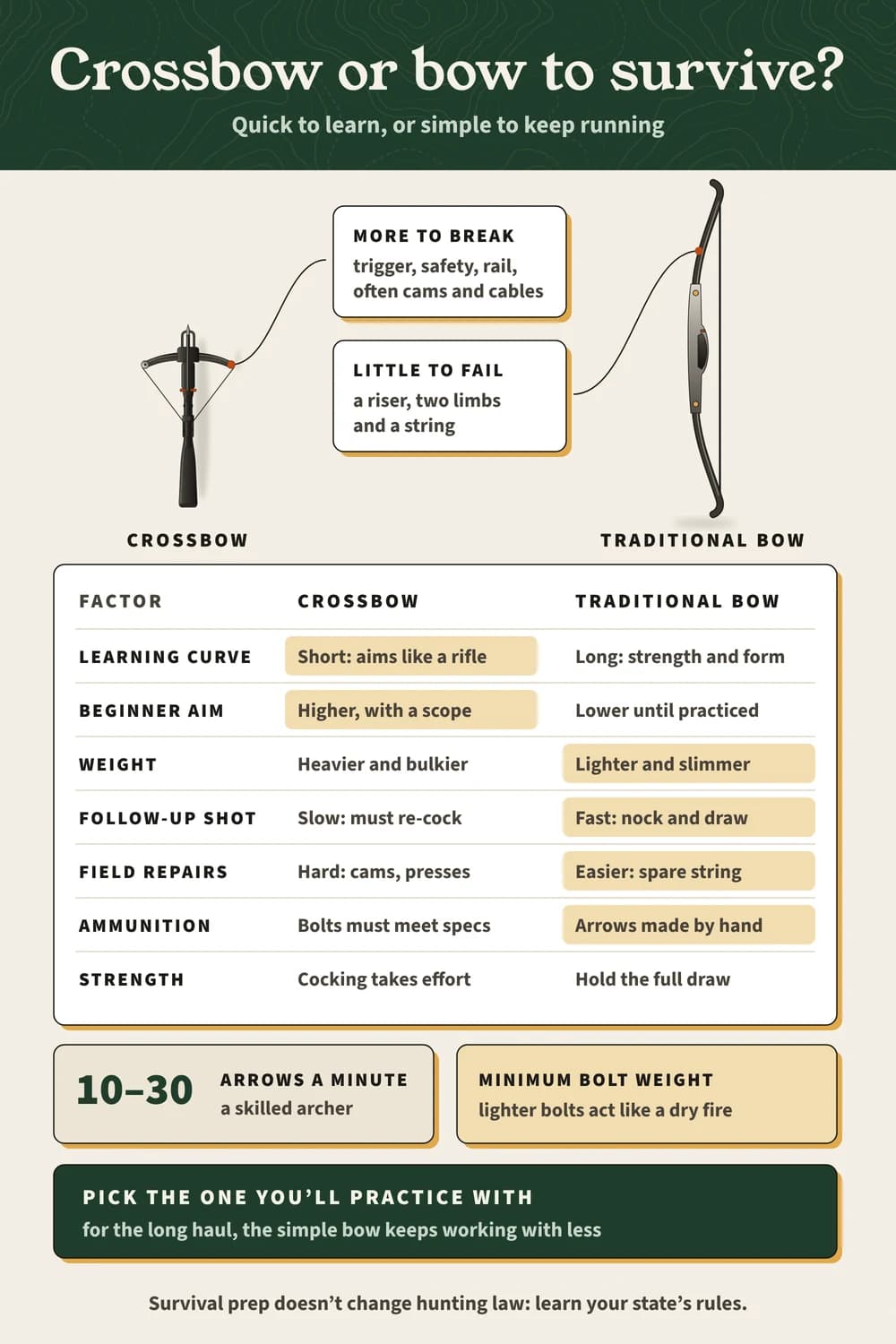
| Factor | Crossbow | Traditional bow |
|---|---|---|
| Learning curve | Short: aims like a rifle | Long: needs strength and form |
| Accuracy for a beginner | Higher, with a scope and stock | Lower until you’ve practiced |
| Weight to carry | Heavier and bulkier | Lighter and slimmer |
| Follow-up shot | Slow: must re-cock | Fast: nock and draw |
| Field repairs | Hard: triggers, cams, presses | Easier: spare string and stringer |
| Ammunition | Bolts must meet maker specs | Simple arrows can be made by hand |
| Strength needed | Cocking takes effort; no holding at full draw | You hold the full draw weight every shot |
Simplicity usually wins over time, but only if you’ve built the skill to use it.
Survival archery pros and cons
Neither tool wins every time. Here’s how archery stacks up when it’s your food on the line.
Pros
- Quieter than a firearm, so you’re less likely to spook game or give away your spot
- Arrows and bolts can often be recovered and reused
- Traditional bows need little maintenance
- Works for game from rabbits to deer with the right points
Cons
- Both need real practice to hunt ethically
- Running out of arrows or bolts can end your hunting
- Crossbows add weight and moving parts
- Wind, rain and thick brush cut your effective range
Survival archery tips: practice, upkeep and the law
- Practice now: shoot regularly at the distances you’d hunt.
- Carry spares: a spare string, extra points and a few broadheads.
- Build strength: drawing a bow is a workout, so try these archery exercises.
- Keep it dry: wax your string and protect your gear from rain.
- Learn the rules: hunting seasons, licenses and crossbow rules vary by state.
Here’s the whole comparison on one page, so you can see where each tool wins.
// FAQ
Frequently asked questions
Quick answers to the questions readers ask most.
Is a crossbow or a bow better for survival?
For a beginner who needs to be accurate soon, a crossbow. For long-term self-reliance, a simple bow is lighter, easier to repair and easier to supply with arrows.
Can archery skills be self-taught for survival?
Yes, with videos, books and regular practice. A coach or an experienced archer at a range speeds it up and catches form mistakes early.
Can you make your own crossbow bolts in the wild?
Not reliably. Bolts must meet your crossbow’s length, nock and minimum weight, and a bolt that’s too light can damage it.
How do I keep a bow or crossbow working in the field?
Keep it dry, wax the string and check limbs and strings for damage before you shoot. Pack a spare string and the tools to fit it.
Is it legal to hunt with a crossbow anywhere?
No. Crossbow rules, seasons and license requirements vary by state, so check your state wildlife agency before you hunt.

Final thoughts
For long-term survival, pick the simple bow and practice with it now. A crossbow gets you accurate faster, but a simple bow keeps working longer with less.
Whichever you pick, track your practice. My free range log is a good place to begin, and you can compare options in my best crossbows guide.
