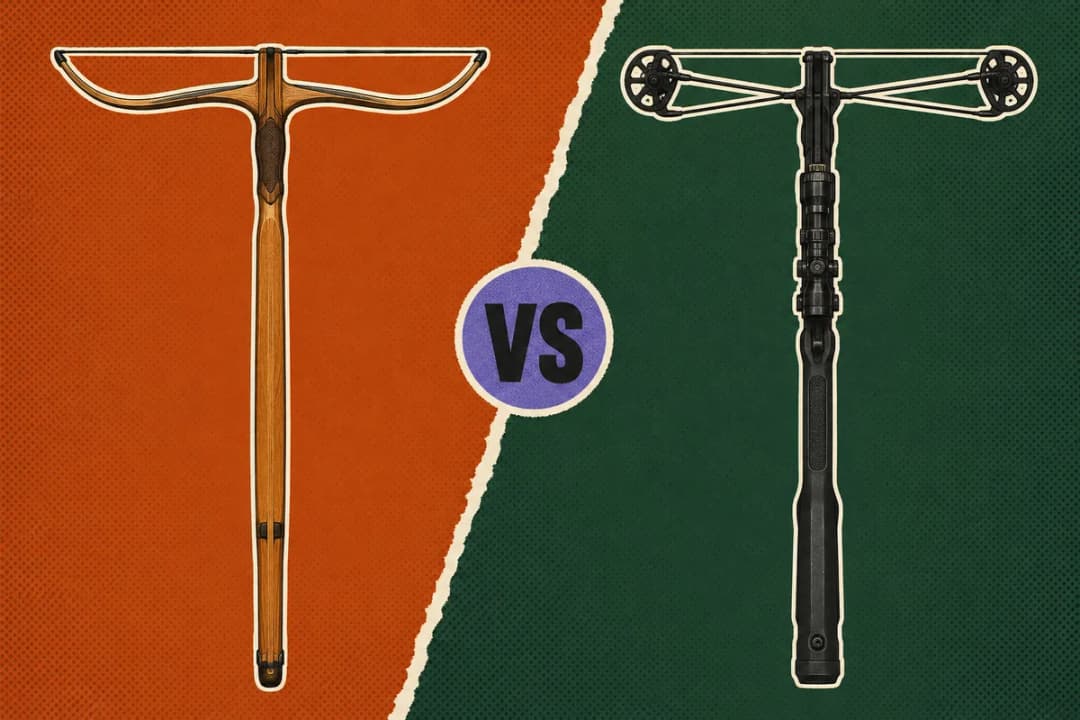


- Modern hunting crossbows come in 3 main types: recurve, compound and reverse draw.
- Recurve crossbows are the simplest and easiest to maintain; compound crossbows are narrower and more powerful.
- Pistol crossbows are for targets, not hunting, and many states ban them for game.
- Repeating crossbows and stonebows are historical types you’ll mostly see in museums and collections.
Recurve, compound, reverse draw, pistol, repeater: the listings throw them all at you, but only three matter if you hunt. 🧐
Choose between a recurve, a compound and a reverse-draw crossbow, and buy from a shop that will fit and set it up, because the wrong type can be too wide for your blind or not legal for deer. Here’s how each works, with the parts of a crossbow explained.
Types of crossbows compared: which one fits you
Every crossbow has the same basic parts: a stock, a rail (or barrel), limbs, a string and a trigger. What makes the types different is how the limbs store energy, and how big and heavy that makes the bow. My crossbow anatomy guide names every part.
| Type | How it works | Best for | Watch out for |
|---|---|---|---|
| Recurve | Limb tips curve away from the shooter; no cams | Simple, rugged hunting setups | Wider and often louder |
| Compound | Cams and cables store energy in short, stiff limbs | Most deer hunters today | More parts to maintain |
| Reverse draw | Limbs face backward, so weight sits closer to you | Balance and speed | More complex to service |
| Pistol | Small, light, one-handed bow | Target practice | Not legal for hunting in many states |
| Youth or compact | Shorter, lighter, lower draw weight | Young or smaller shooters | May be below your state’s hunting minimum |
| Repeating | Lever-fed magazine of bolts | History and collections | Short range, not a hunting tool |
| Stonebow | Shoots stones or pellets | History | Collector item today |
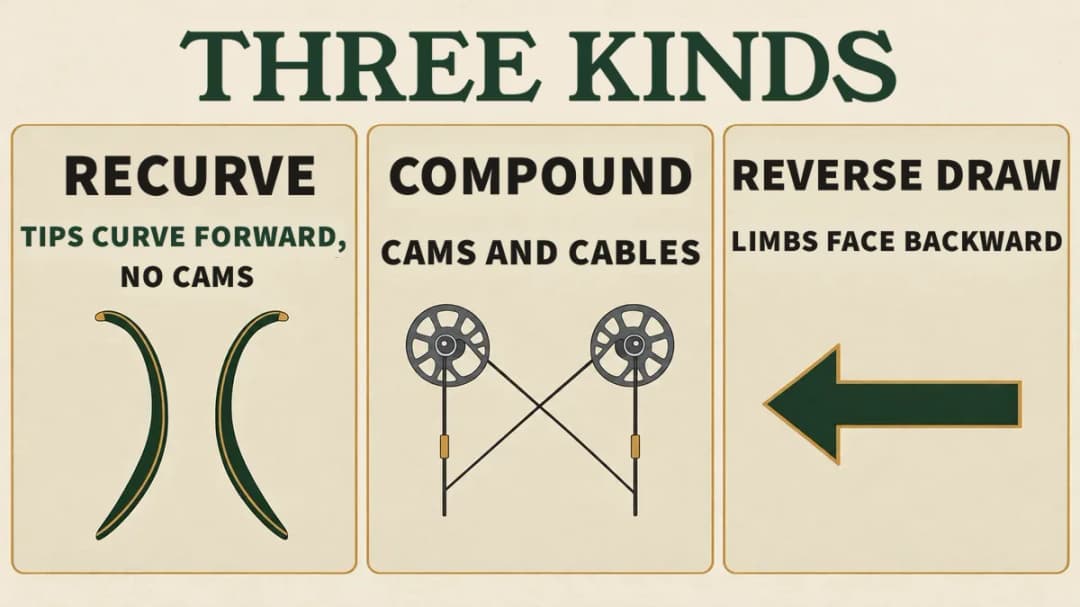
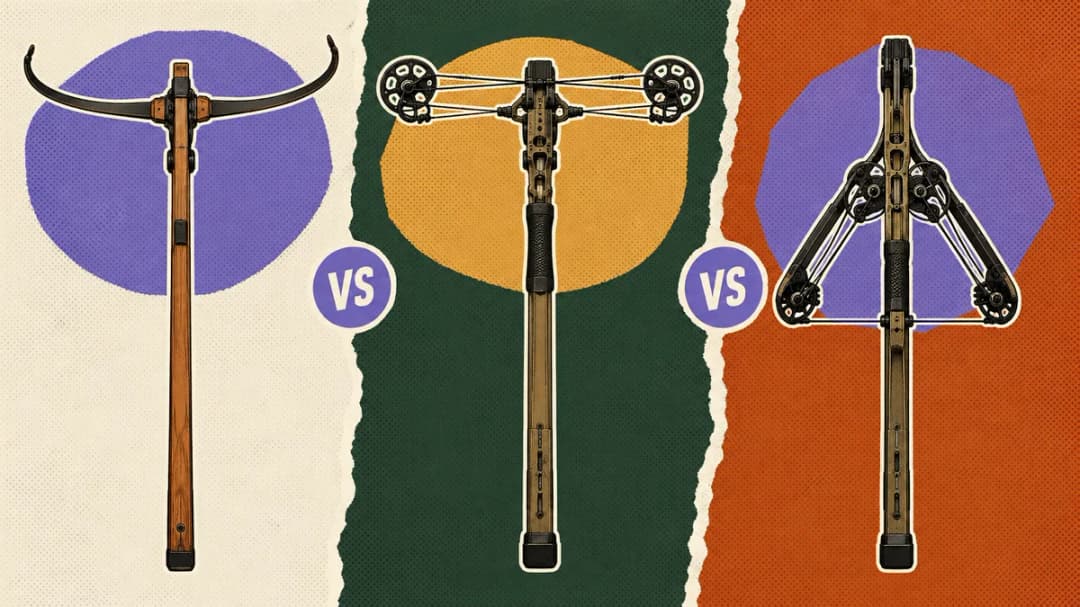
Pyramyd AIR’s video below puts the three hunting designs side by side: recurve, forward-draw (compound) and reverse-draw. Watch where the limbs sit on each one; that one detail explains most of the differences.
// Free printable
Get the range log I actually use.
Seventeen printable pages: session log, score tracker, a 30-day drill challenge, a bow maintenance card, a first-season checklist and more. Join the monthly email and it lands right away.
1. Recurve crossbows: simple, rugged and easy to maintain
A recurve crossbow has limbs whose tips curve away from the shooter, like a traditional recurve bow. With no cams or cables, there’s less to go wrong, and a string change is much easier.
The trade-off is size and noise. Recurve crossbows tend to be wider at the limbs and louder at the shot than compounds of similiar power. See my best recurve crossbows for current models.
Pyramyd AIR’s video in the section above adds one more trade-off that’s easy to miss, and it’s in the trigger:
The other way mechanically to think about this crossbow is it starts out light draw and gets heavier and heavier and heavier as you pull it back, and what that means is, once it hits the trigger box, your trigger box is actually holding the entire weight of the draw of the crossbow.
Cams change that on a compound, so the trigger holds less. On a recurve crossbow, try the trigger before you buy; a heavy, gritty pull costs more accuracy than a few fps ever will.
They’re not just for show: with the right bolt and broadhead, a recurve crossbow can take big game.
2. Compound crossbows: compact power for deer hunting
A compound crossbow uses cams and cables to store energy in short, stiff limbs. That makes it narrower and more powerful for its size, which is why it’s the most common choice for deer hunters today.
The cams need more care than a recurve’s plain limbs and a string or cable change usually needs a crossbow press. For the top current models, see my best crossbows list.
3. Reverse-draw crossbows: better balance, closer to you
On a reverse-draw crossbow, the limbs face backward, with the cams pointing toward the shooter. That moves the weight back toward your hands, so the bow feels balanced and steadier to hold.
The same video explains why that balance matters when you hold a crossbow up to aim:
Here the limbs are actually mounted back by the trigger box. What that does is it brings the weight of the bow to where your natural position is going to be, so what you’re going to find holding this bow is that it’s very well balanced and actually feels lighter than heavier bows that are forward draw.
Note the word “feels”. Balance changes how heavy a crossbow feels, not what it weighs, so check the real weight on the spec sheet if you’ll carry it far, then hold one at a shop if you can.
The design also lets the string travel farther for its size, which helps speed. The TenPoint Nitro 505 is one well-known reverse-draw model, and independent tests measured it at about 515 fps with 400-grain bolts.
They’re more complex to service. So they suit hunters who don’t mind a pro shop doing maintenance. My best reverse-draw crossbows list covers the options, and best crossbows for beginners list helps if you’re just starting.
4. Pistol crossbows: fun at targets, not for game
A pistol crossbow is a small, one-handed crossbow. Many have draw weights around 50–80 lb, far below what states require for deer.
They’re fun for backyard target practice with the right bolts and a safe backstop. Treat one with the same respect as a full-size crossbow: it still shoots a bolt that can hurt someone.
5. Youth and compact crossbows: lighter and shorter
Youth and compact crossbows are shorter, lighter and usually lower in draw weight. They suit young or smaller shooters who struggle to hold a full-size bow steady.
Before you buy one for hunting, check two things: the minimum draw weight in your state and the age rules for young hunters.
6. Repeating crossbows: the Chinese chu-ko-nu
A repeating crossbow has a magazine of bolts on top. You work a lever to cock, load and shoot in one motion, so you can loose bolts quickly.
It’s often called the chu-ko-nu after the Chinese strategist Zhuge Liang, but the oldest known example, a double-shot model from a 4th-century BC tomb of the State of Chu, is far older than him. Its range was short, and it stayed in use in China into the 19th century, often as a defensive weapon.
For more crossbow history, read about the medieval arbalest and crossbows in modern militaries.
7. Stonebows (bullet crossbows): pellets instead of bolts
A stonebow, sometimes called a bullet crossbow, shoots stones or clay or lead pellets instead of bolts. In 16th-century Europe it was a specialist tool for shooting birds and small game.
Stonebows faded once firearms became more reliable. Today they’re collector pieces.
Crossbow cocking systems: rope, crank or built-in
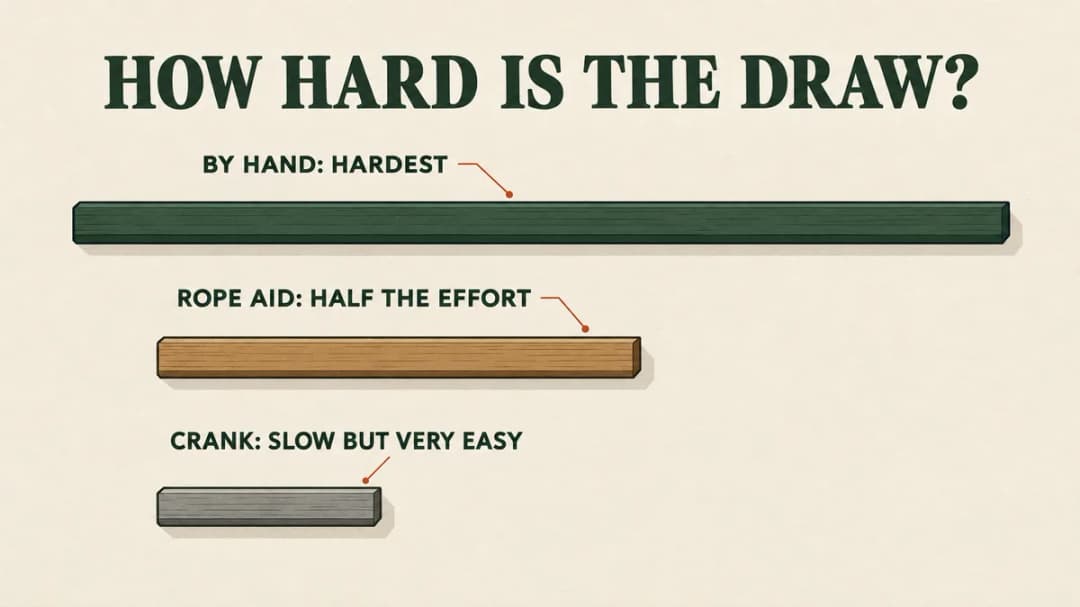
Beyond limb type, crossbows differ in how you pull the string back. The cocking system matters as much as the type if you have shoulder or back trouble.
- By hand: you pull the string to the latch with your hands; hard work on modern draw weights.
- Rope cocker: a cord with handles that halves the effort and centers the string.
- Crank cocker: a winch you turn by hand; slow but very easy, and many can also de-cock safely.
- Built-in systems: some bows have a crank or lever built into the stock.
Which type of crossbow should a beginner buy?
This advice comes from maker specs and owner reports, not my own shooting. If I were buying for deer, I’d start with a recurve crossbow from a shop where someone can fit and set it up: on paper it has the fewest parts to tune. Pick a compound if you hunt from a tight blind or stand.
Whatever you choose, pair it with a good crossbow scope and practice at real distances.
More crossbow hunting tips for your first season
- Check your state’s rules on draw weight and seasons, for example in New York.
- Practice at a range with proper crossbow targets.
- Use the right broadheads: see my best broadheads.
- Inspect strings, cables and limbs before every hunt.
- Wait for a clear, close shot for a clean, ethical harvest.
Advantages and disadvantages of crossbow hunting
Crossbows make archery hunting easier to start. They also bring weight and maintenance you don’t have with a vertical bow.
Pros
- Stays cocked, so you don’t hold a draw while you wait
- A scope makes accurate shots easier to learn
- Good option for hunters who can’t draw a vertical bow
- Legal in archery seasons in many states
Cons
- Heavier and bulkier than a vertical bow
- More moving parts to maintain
- Slower to reload for a follow-up shot
- Restricted in some states and seasons
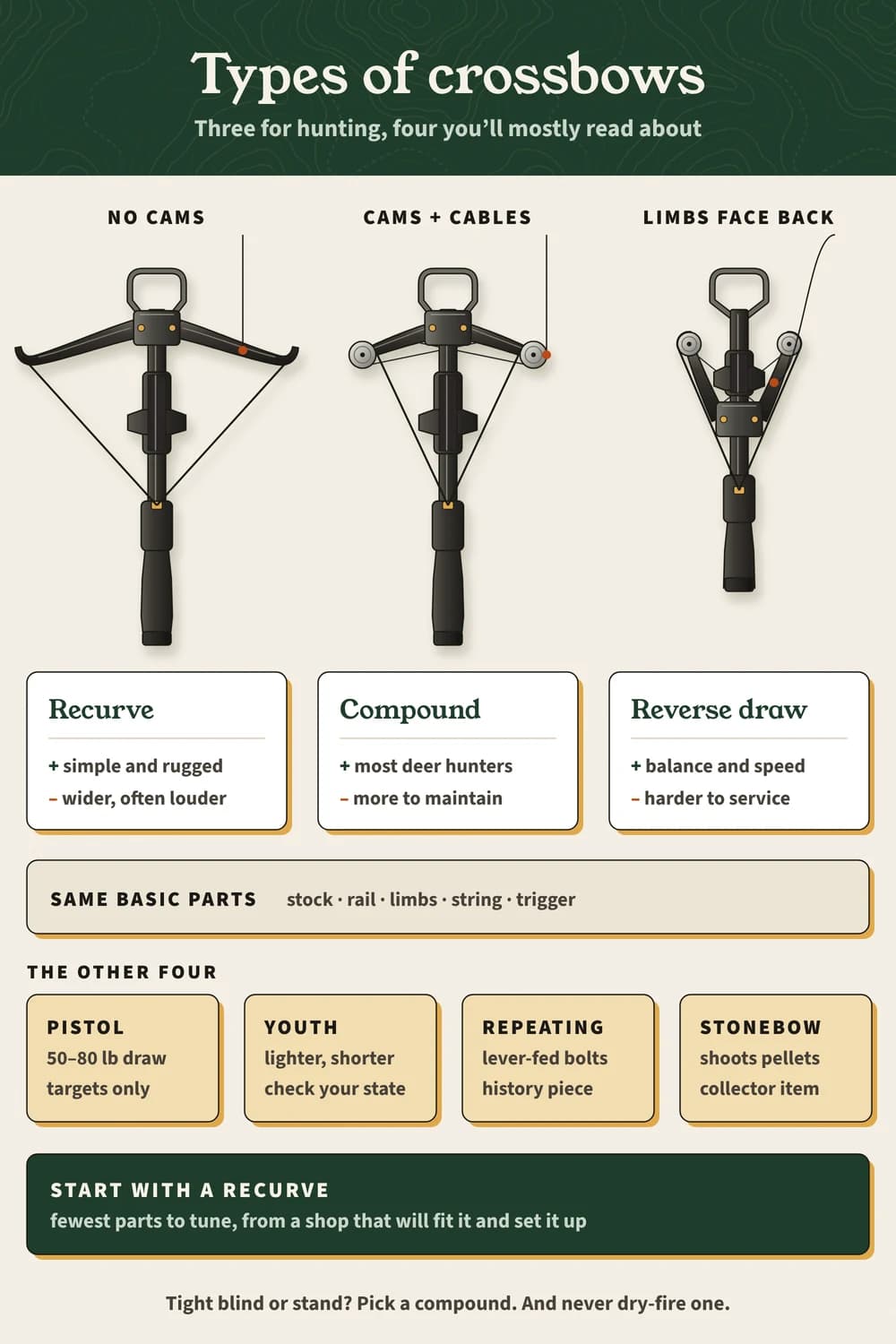
If you'd rather see the whole lineup side by side, here are all seven types on one page, with the one I'd start on.
// FAQ
Frequently asked questions
Quick answers to the questions readers ask most.
What are the main types of crossbows?
For hunting, the main types are recurve, compound and reverse-draw crossbows. Pistol, youth, repeating and stonebow crossbows are niche or historical.
Is a recurve or compound crossbow better for beginners?
A recurve, if you want the fewest parts to maintain. A compound is narrower and more powerful for its size, which is why most deer hunters end up with one, so pick it if you hunt from a tight blind or stand.
What draw weight do I need for a hunting crossbow?
Your state sets the minimum, so check it first: Pennsylvania requires 125 lb and Maine 100 lb, for example. Most full-size hunting crossbows sold today meet those minimums.
Can you hunt with a pistol crossbow?
Usually not for deer: most pistol crossbows fall below state draw-weight minimums, and some states ban them outright. Check your state wildlife agency.
Do I need a cocking device for my crossbow?
Get one. It’s not required, but a rope or crank cocker makes cocking easier and centers the string for more consistent shots.
What’s the safest way to transport a crossbow?
Uncocked, unloaded and in a padded case. My guide on how to transport a crossbow safely has the full checklist.

Final thoughts
For hunting, the choice comes down to recurve, compound or reverse draw. Recurves are simple, compounds are compact and powerful, and reverse-draw bows balance best.
Check your state’s draw-weight rules, try a few in a shop, and pick the one you can cock and hold comfortably. Then log your practice in my free range log, so you go into your first season knowing your range.
