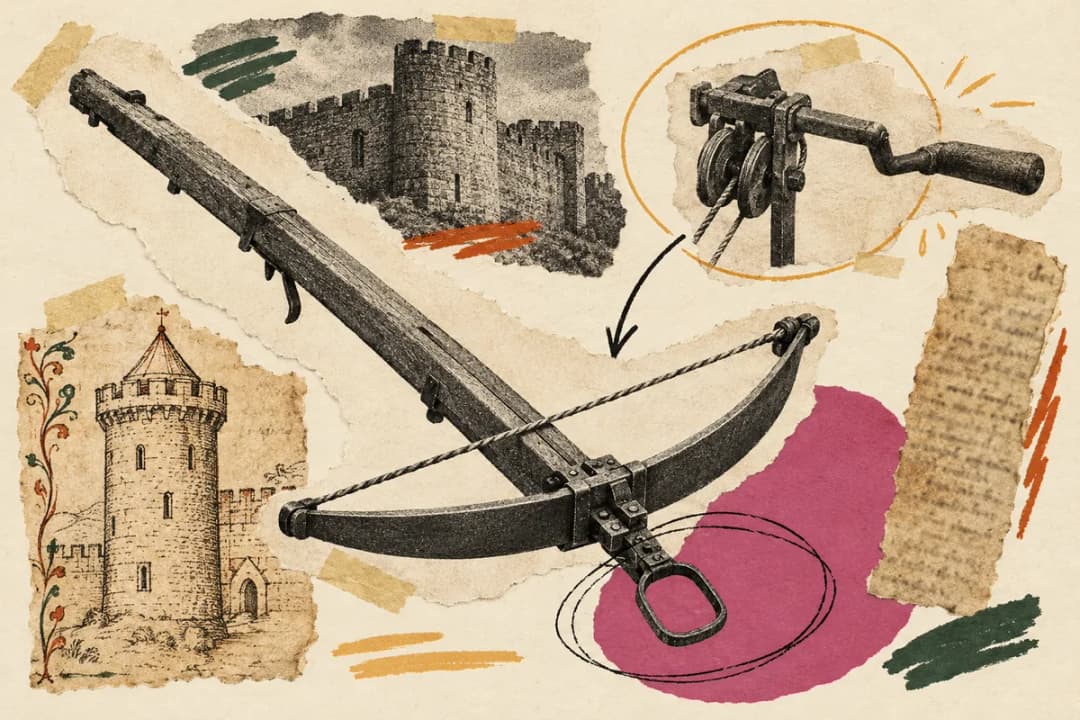


- An arbalest is a large medieval crossbow, best known for its heavy steel prod (bow).
- The arbalest came into use in Europe around the 12th century; steel prods arrived in the 14th century and were common by the 15th.
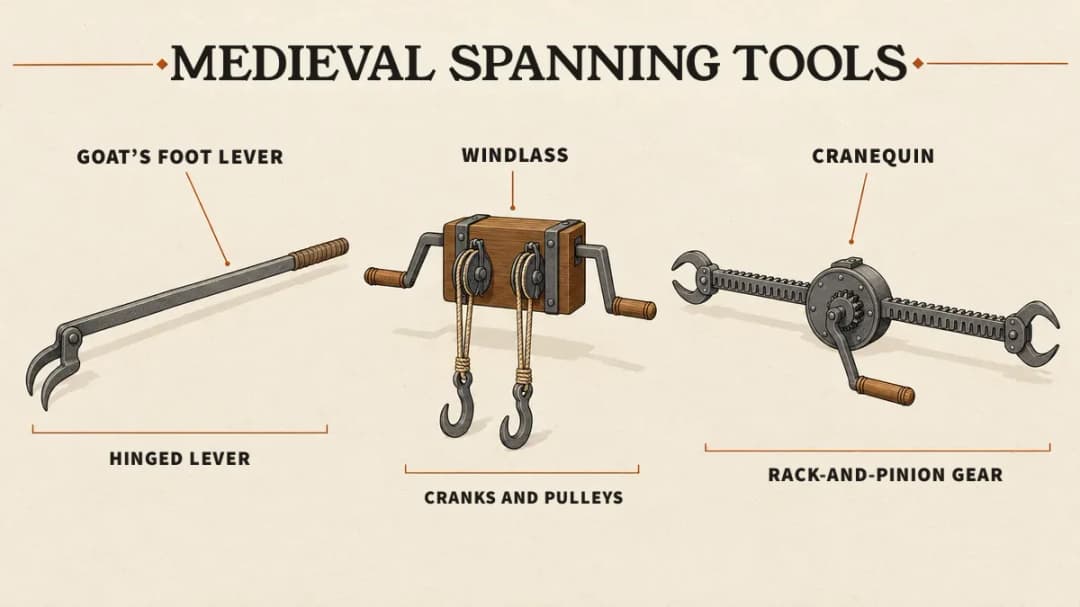
- It was too strong to draw by hand, so crossbowmen used a windlass or cranequin to span it.
- A rotating nut of antler, bone or metal held the string until the trigger released it.
- It needed less training than a longbow but was much slower to reload.
Imagine a crossbow so strong that no human arm could draw it, so you cranked it back like a winch. 😮
That’s the arbalest: a big European crossbow with a steel prod, so powerful it needed a crank to draw. Maybe you met the word in a game, a book or on a museum label. See how it worked and how it compares with today’s types of crossbows, and you’ll understand why your modern crossbow is built the way it is.
What is an arbalest? A steel-prod crossbow from medieval Europe
The arbalest (also spelled arblast) is a variation of the crossbow that came into use in Europe around the 12th century. The name comes from the Latin arcuballista, from arcus (bow) and ballista (a missile-throwing engine).
Today the word usually means a large crossbow with a steel prod, the bow part mounted across the stock. Some writers use “arbalest” for any medieval crossbow, so the term is a little lose.
Part of what pulled me into archery was how fast archers can shoot and reload. The arbalest is the opposite trade: huge power per shot, and a slow crank between shots.
I was always interested in how fast you could shoot, like how many arrows could you shoot at once, how quickly can you reload.

// Free printable
Get the range log I actually use.
Seventeen printable pages: session log, score tracker, a 30-day drill challenge, a bow maintenance card, a first-season checklist and more. Join the monthly email and it lands right away.
History of the arbalest: from ancient crossbows to steel prods
The arbalest didn’t invent the crossbow. Crossbows were a main weapon in China during the Warring States period (475–221 BC), and the Greek gastraphetes, or “belly bow,” dates to the late 5th or 4th century BC (sources disagree).
The rise of the crossbow in medieval Europe
Crossbows spread across medieval Europe because they needed far less training than a longbow. A soldier could learn to aim one quickly, while a skilled longbowman trained for years.
Crossbows worried the church enough that the Second Lateran Council of 1139 condemned crossbowmen and archers fighting against Christians. The ban was widely ignored, and crossbows only grew more powerful.
From wood to composite to steel
Early prods were wood. Composite prods of wood, horn and sinew appeared around the end of the 12th century, and steel prods came into use in the 14th century, as steel got easier to make, and were common by the 15th.
Steel made the prod very stiff, but it also had a short draw length, which limited how much of that strength reached the bolt. So a much heavier draw didn’t always mean a proportionally faster bolt.
How an arbalest was drawn: spanning devices compared
A steel prod was far too strong to pull by hand. Crossbowmen used spanning devices, each one trading speed for power.
| Spanning method | How it works | Used for |
|---|---|---|
| Hand and stirrup (belt hook) | Foot in the stirrup, string pulled back with the hands or a hook on the belt | Lighter crossbows |
| Goat’s foot lever | A hinged lever pries the string back to the nut | Medium crossbows, in use from the 14th century |
| Windlass | Cranks and pulleys wind the string back | Heavy steel-prod and rampart crossbows; winches appear from the 13th century |
| Cranequin | A rack-and-pinion gear wound with a handle | Heavy crossbows, including 16th-century sporting crossbows |
Skallagrim, a YouTuber who tests historical weapons and armor, shoots a replica 15th-century crossbow spanned with a windlass in the video below. He answers the question everyone has about it:
If you’re wondering how hard it is to span this crossbow, the mechanical advantage of the windlass makes it fairly easy. It’s only towards the end where the resistance gets a little higher, but it’s not difficult… Although I can say after half a day of doing this over and over again I did feel it in the arms and back a little bit.
That’s the arbalest’s whole trade in one answer. The windlass made a huge draw weight easy, not fast: every shot meant winding the string all the way back, which is why crossbowmen needed a pavise to hide behind.
Once spanned, the string sat behind a rotating catch called the nut. Nuts were made of antler, bone or metal, and a trigger lever released the nut to fire the bolt, called a quarrel.
In the video below, Skallagrim spans his replica 15th-century crossbow with a windlass and shoots it into mail and padded armor. Watch how much effort spanning takes.
Arbalest materials and parts: what it was made of
An arbalest had the same basic parts as the crossbow you can buy today. Only the materials and the mechanics have changed.
- Prod: the bow, in wood, composite (wood, horn and sinew) or steel.
- Stock (tiller): the wooden body that holds the prod, the nut and the trigger.
- Nut: the rotating catch of antler, bone or metal that holds the string.
- Trigger lever: a long lever under the stock that turns the nut and releases the string.
- Quarrel: the short, heavy bolt, often with a square-section head.
Here’s how the three prod types compare. Each step made the crossbow stronger and more durable.
| Prod type | Materials | Typical spanning | Era in Europe |
|---|---|---|---|
| Wood | A single wooden bow | Hand and stirrup | Early medieval |
| Composite | Wood, horn and sinew | Belt hook or lever | From the end of the 12th century |
| Steel | Steel | Windlass or cranequin | 14th century onward |

For the modern names of these parts, see crossbow anatomy. The prod became the limbs, and the nut became the trigger’s latch.
Arbalests on the battlefield: pavises and Crécy
Slow reloading left crossbowmen exposed. They often shot from behind a pavise, a tall shield propped up so the shooter could reload behind it.
At the Battle of Crécy in 1346, Genoese crossbowmen fought for France without their pavises, which had been left with the baggage. English longbowmen out-shot them, a famous example of the crossbow’s reload problem. A rainstorm that may have soaked their strings is often blamed too, though historians still debate it.
Arbalest advantages and disadvantages
The arbalest was a trade-off between power, training and speed. Here’s how it stacked up against a longbow.
Pros
- Needed far less training to use well
- Didn’t require the shooter to hold the draw while aiming
- Steel prods were powerful and durable
- Usable by soldiers without an archer’s strength
Cons
- Much slower to reload than a longbow
- Heavier and bulkier to carry
- Needed spanning gear that could break or be lost
- Exposed the shooter while reloading without a pavise
Those trade-offs still shape crossbows today. Modern crossbows fix most of the weaknesses with light limbs, rope cocking aids and scopes; see the types of crossbows and the best recurve crossbows.
And Skallagrim also shows why the scope is the biggest of those fixes. Shooting at a small target, he explains what aiming without one means:
So the difficulty with aiming here is because you don’t have sights, you have to put the tip of the bolt a certain point above or below the target depending on the distance.
Medieval crossbowmen aimed the way he does, judging the drop by eye. A modern crossbow scope does that judging for you with an aiming point for each distance, as long as you know how far away the target is.
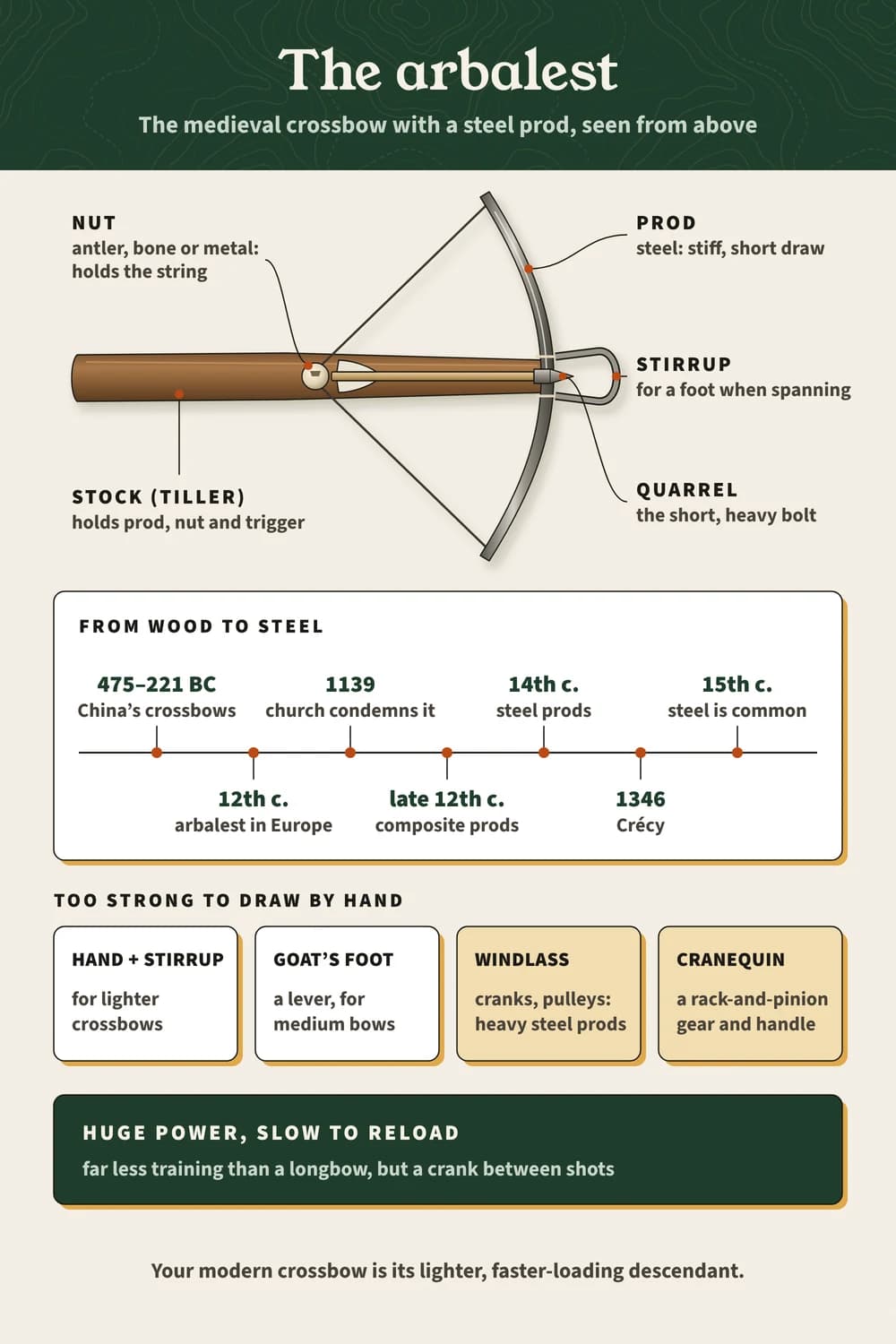
To see the whole story in one picture, from the prod to the crank, here's the arbalest on a single page.
// FAQ
Frequently asked questions
Quick answers to the questions readers ask most.
How does an arbalest differ from a regular bow?
An arbalest is a crossbow: the string is locked back mechanically and released with a trigger. You don’t hold the draw, so it needs less strength and training to aim, but it’s much slower to reload.
What is the difference between an arbalest and a crossbow?
Every arbalest is a crossbow, but not every crossbow is an arbalest. The word usually means a large crossbow with a steel prod, spanned with a windlass or cranequin.
Were crossbows only used in medieval Europe?
No. China used crossbows widely during the Warring States period (475–221 BC), and the Greek gastraphetes dates to the late 5th or 4th century BC.
What is an arbalist?
An arbalist (or arbalester) is a soldier who shot an arbalest or crossbow. Genoese arbalists were famous mercenaries in medieval wars.
Are crossbows still used today?
Yes, by hunters, target shooters and a few military special forces. Modern crossbows use light limbs and scopes instead of steel prods and cranks.

Final thoughts
The arbalest was the heavy hitter of the medieval crossbow family: a steel prod, a crank to draw it and a slow but powerful shot. It traded speed for power and training time.
Your modern crossbow is its descendant, lighter and faster to load. If you’re ready to own one, start with the best crossbows for beginners, and log your practice in the free range log.
