

- A crossbow can kill, but it lacks a quick follow-up shot, so it’s a poor primary home defense tool.
- Manufacturers say never store a crossbow cocked or loaded, which means it isn’t ready when you need it.
- Training and practice matter more than gear in any high-stress situation.
- Shooting a person with a crossbow is deadly force, judged under your state’s self-defense laws.
- Locks, lights, an alarm and a plan to call 911 do more for most homes than any bow.
A noise downstairs, no gun in the house, a hunting crossbow in the closet. Would it actually protect your family? 😟
Honestly: it’s legal to use, but it’s a weak home defense tool. It’s single-shot, slow to reload and unsafe to keep cocked. Know those limits and you can build a plan that really keeps your home safe.
Can you use a crossbow for self-defense? Yes, with hard limits
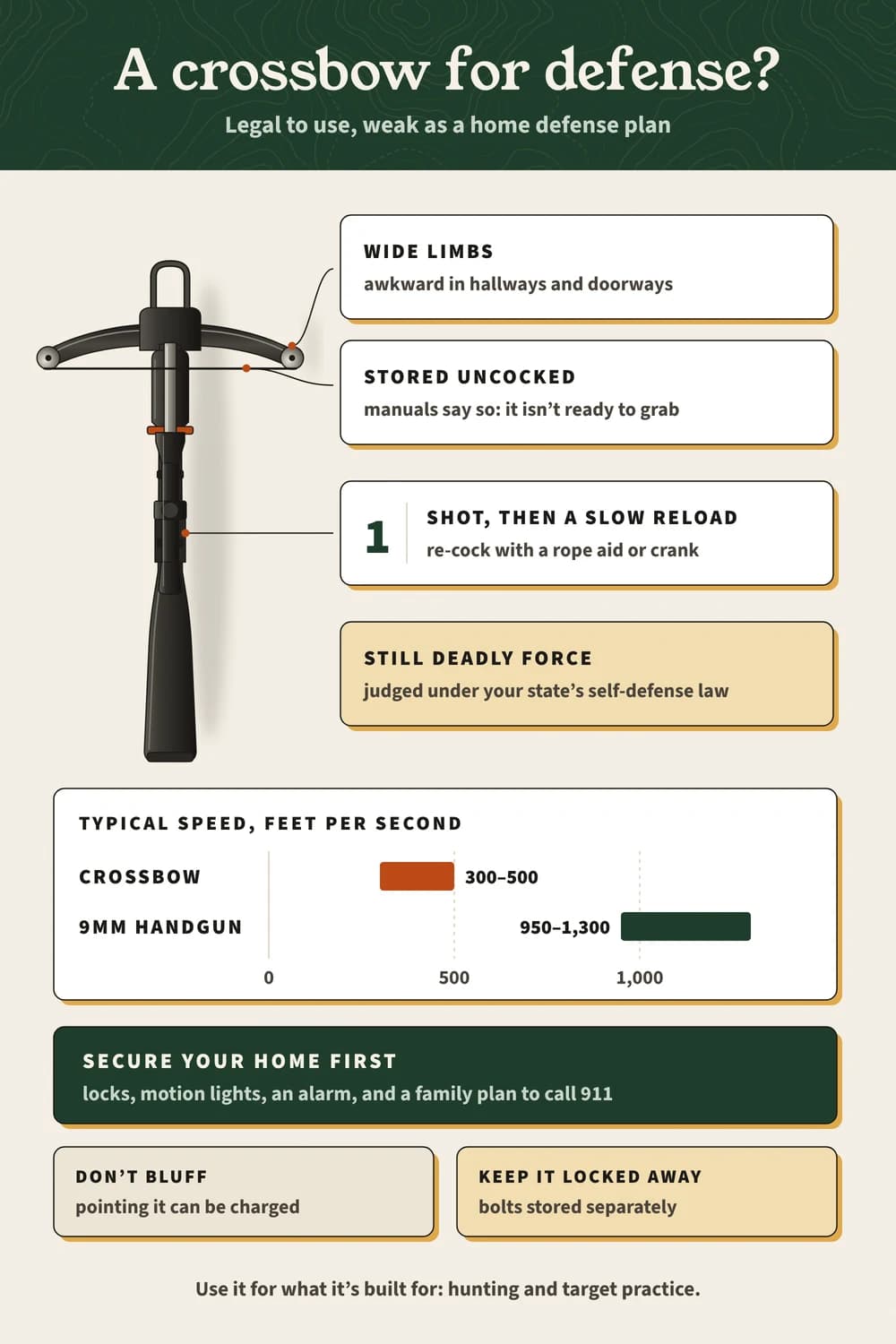
A modern crossbow throws a 400-grain bolt at 300–500 feet per second, and a broadhead can be lethal. Power isn’t the problem; readiness and follow-up shots are.
- One shot, then a slow reload: you have to re-cock with a rope aid or crank and nock a new bolt.
- Not ready to grab: manuals say to store crossbows uncocked and unloaded.
- Hard to handle indoors: limbs are wide, and a bolt can go through walls.
- Same legal weight as any deadly weapon: the rules on deadly force still apply.
I’m a former Marine, an infantry machine gunner who served in Afghanistan, so firearms are familiar ground for me. Crossbows aren’t: I haven’t shot one yet, so this post sticks to specs, manuals and the law rather than my own crossbow experience.
I'm a former US Marine. I was in the infantry, let's say 2010 to 14, and I served in Afghanistan, and firearms come second nature to me.

// Free printable
Get the range log I actually use.
Seventeen printable pages: session log, score tracker, a 30-day drill challenge, a bow maintenance card, a first-season checklist and more. Join the monthly email and it lands right away.
Crossbow vs firearm for home defense: how they compare
The numbers show why a crossbow makes a poor defense tool. A handgun bullet is roughly two to four times faster, and the gun holds more than one shot.
| Feature | Hunting crossbow | 9mm handgun |
|---|---|---|
| Projectile weight | Bolt of about 300–500 grains | Bullet of about 115–147 grains |
| Speed | About 300–515 fps (the fastest, like the TenPoint TRX Ultra, are rated 515) | About 950–1,300 fps, depending on the load |
| Shots before reloading | 1 | Several, depending on the magazine |
| Reload | Re-cock with a rope aid or crank, then nock a bolt | Swap a magazine |
| How it wounds | Broadhead cuts blood vessels | Bullet crushes and stretches tissue |
| Safe storage | Uncocked and unloaded, per manuals | Depends on the firearm and local storage laws |
| Legal use | Deadly force rules apply | Deadly force rules apply |
Stopping power and speed
Hunter-education courses teach that broadheads kill by cutting blood vessels, so an animal hit well can still travel before it drops, that delay is acceptable for a deer and a serious problem with a person coming at you.
Rate of fire
A crossbow gives you one shot. If you miss or the threat keeps coming, you’re holding an empty crossbow while you try to re-cock it with shaking hands.
Crossbow features that matter if you keep one at home
If a crossbow is part of your household, these features make it safer to own. None of them fixes the single-shot problem.
Safe cocking and de-cocking
A built-in crank or de-cocking system lets you unload without firing a bolt. Anti-dry-fire protection guards the crossbow if the trigger is pulled with no bolt.
Scope and bolts
A quality crossbow scope and matched bolts help accuracy. Indoors, though, most distances are short, and a scope can be a hindrance in a dark hallway.
When a crossbow might help, and when it won’t
There are narrow cases where a crossbow is better than nothing. They depend on distance and time to prepare.
Against an attacker at a distance
Against someone with a knife or club who is still some distance away a ready crossbow gives you reach. That only works if it’s already cocked, which you shouldn’t do in storage.
The intimidation myth
It’s tempting to think the sight of a crossbow will scare someone off. Pointing any deadly weapon at a person can itself be charged as aggravated assault in states like Texas and Florida if it isn’t justified, so don’t rely on it as a bluff.
Crossbow self-defense laws: deadly force rules still apply
A crossbow is a lethal weapon, so shooting a person with one is deadly force. Whether that’s lawful depends on your state’s self-defense laws, not on the type of weapon.
Castle doctrine, stand your ground and duty to retreat
Every state recognizes some form of castle doctrine for your home, though the conditions differ. Roughly 12–15 states still have a duty to retreat in public when it’s safe to do so; the other 35 or so are stand-your-ground states, and counts vary with how each law is read.
Responsible ownership
As the owner, your responsible for storing and using your crossbow legally. Know your state’s laws before an emergency, not after.
Home defense tips that work better than a crossbow
Most home defense is about not needing a weapon at all. Start with the basics:
- Lock doors and windows, and add motion lights outside.
- Install an alarm or camera system as a visible deterrent.
- Make a family plan: a safe room, a phone, and a call to 911.
- Take a self-defense or home-safety course for your area.
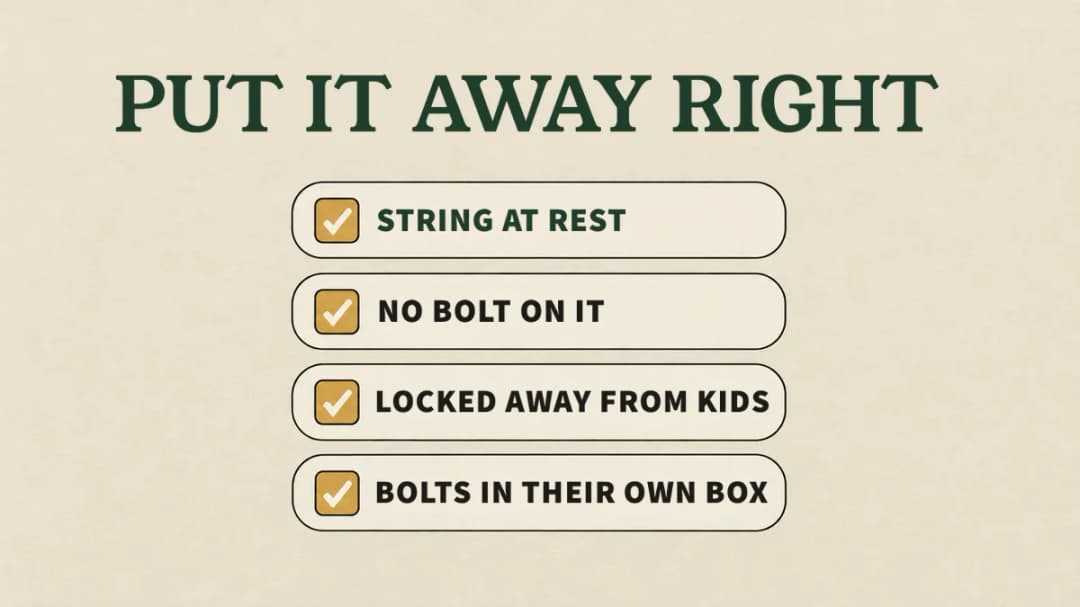
- If you keep a crossbow, store it uncocked in a locking crossbow case, with bolts in a separate crossbow quiver.
If you’re weighing a crossbow against other options, compare the do’s and don’ts. Most of them are about preparation, not power.
| Do's | Don'ts |
|---|---|
| Do learn your state’s self-defense laws. | Don't brandish a crossbow as a threat. |
| Do practice with and maintain your crossbow. | Don't store it cocked or loaded. |
| Do have a backup plan and a phone. | Don't rely on a crossbow as your only defense. |
| Do secure your home first. | Don't leave it where children can reach it. |
Advantages and disadvantages of a crossbow for self-defense
Put side by side, the trade-off is clear. A crossbow is a hunting tool first. For the case in its favor, read my post on reasons to use a crossbow for home defense.
Pros
- Lethal at close range with a sharp broadhead
- Quieter than a firearm
- An option where firearms aren’t owned or permitted
Cons
- One shot, then a slow reload
- Unsafe to store cocked, so it isn’t ready to grab
- Wide limbs are awkward in hallways and doorways
- Still deadly force under the law
This video shows how much power a crossbow carries in test shots. It’s a good reality check on what a bolt can do.
This page sums up the trade-offs, so you can weigh a crossbow against a real home-safety plan.
// FAQ
Frequently asked questions
Quick answers to the questions readers ask most.
Can you carry a crossbow for personal protection?
It’s impractical, and in many places carrying a weapon in public is regulated. Check your state and local laws before carrying a crossbow anywhere but to the range or the field.
Is shooting an intruder with a crossbow legal?
It can be, under the same deadly-force rules that apply to any weapon. Your state’s castle doctrine and duty-to-retreat rules decide it, along with the facts of the case.
How should you store a crossbow at home?
Uncocked, unloaded and locked, with bolts stored separately. That’s what crossbow manuals recommend, even though it means the crossbow isn’t instantly ready.
Is special training needed to use a crossbow for self-defense?
Any defensive tool needs practice under stress. Regular range time and a home-safety course do more than buying a more powerful crossbow.
Is a crossbow better than a knife for home defense?
A ready crossbow gives you distance, which a knife doesn’t. But it’s rarely ready, and a missed shot leaves you with nothing.

Final thoughts
A crossbow can be used in self-defense, and the law treats it like any deadly weapon. As a home defense plan, it’s weak: one shot, a slow reload and storage rules that keep it uncocked.
Use your crossbow for what it’s built for: hunting and target practice. Secure your home first, and explore more guides on Country Bow, including the free range log for your practice sessions.
