

- A crossbow is far quieter than a gun and is not a firearm under US federal law, which is why people consider it for home defense.
- Its big weakness is one shot, then a slow reload that takes both hands and your foot in the stirrup.
- Makers say don’t leave it cocked for long (TenPoint: de-cock daily, never over 24 hours), so it can’t sit ready like people imagine.
- A hunting bolt is built to pass through a deer, so don’t count on walls to stop one.
- Self-defense law applies to any weapon; check your state’s rules before you plan around one.
It’s 2 a.m. and there’s a noise downstairs. 😨
If guns aren’t for your household, a crossbow can look like a smart middle ground, and it has a few real advantages. Honestly, though, it’s a hunting tool, and as a primary home-defense plan it falls short. Here are the 10 reasons people give, each with a reality check, plus the wider crossbow self-defense question.
Crossbow for home defense: the 10 reasons, fact-checked
Each reason below is one you’ll see online. Here’s how each one holds up:
| Reason people give | Reality check |
|---|---|
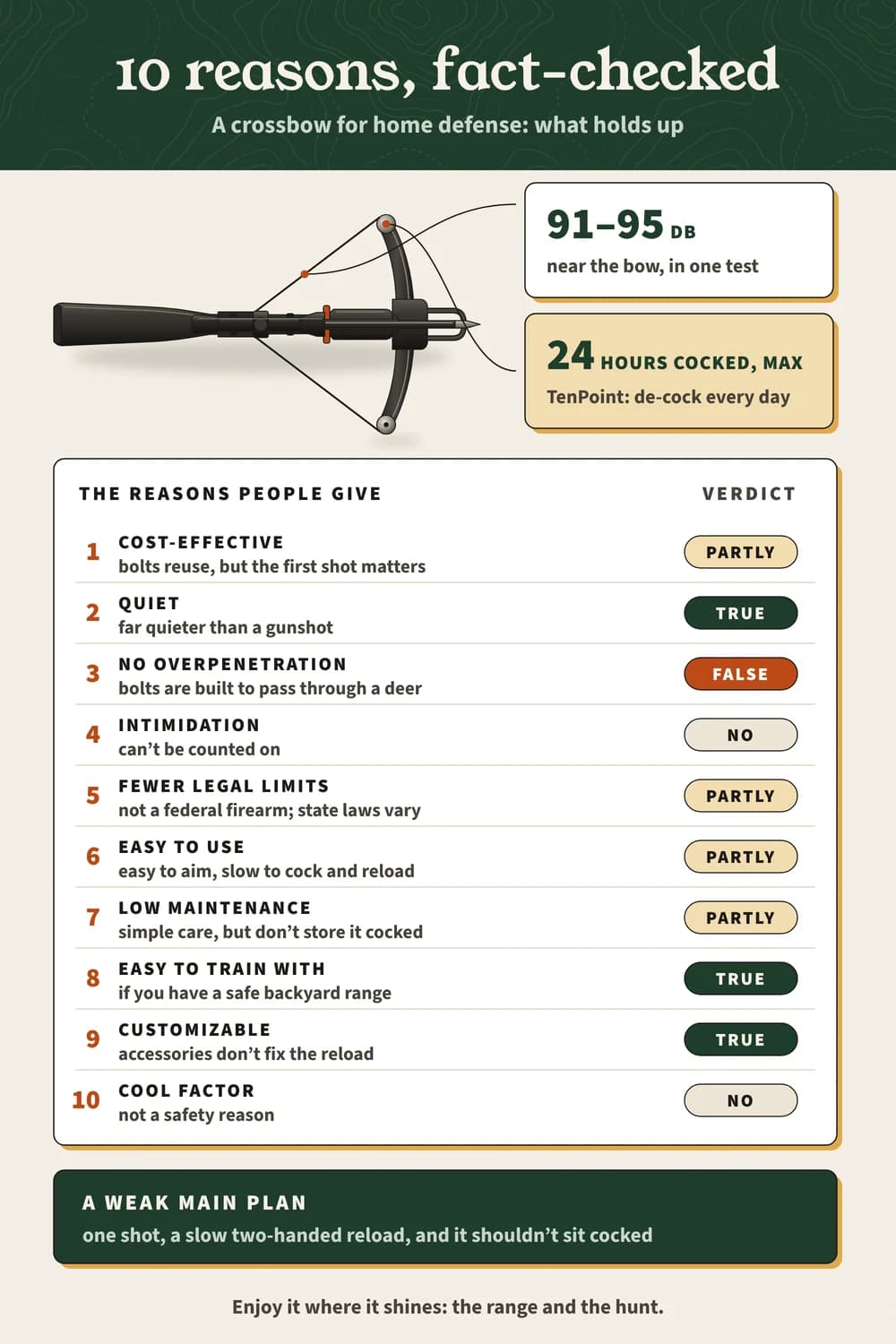
| Cost-effective | Bolts are reusable, but a home-defense plan is about the first shot, not the hundredth |
| Quiet | True: far quieter than a gunshot |
| No overpenetration | False: hunting bolts are built to pass through a deer |
| Intimidation | Can’t be counted on |
| Fewer legal restrictions | Partly: not a federal firearm, but state and local laws vary, and self-defense law still applies |
| Easy to use | Easy to aim, slow and physical to cock and reload |
| Low maintenance | Partly: simple to care for, but it shouldn’t be stored cocked |
| Easy to train with | True, if you have a safe backyard range |
| Customizable | True, but accessories don’t fix the reload problem |
| Cool factor | Not a safety reason |

// Free printable
Get the range log I actually use.
Seventeen printable pages: session log, score tracker, a 30-day drill challenge, a bow maintenance card, a first-season checklist and more. Join the monthly email and it lands right away.
Where a crossbow does well: quiet, simple and easy to practice with
Some of the reasons hold up. These are the genuine strengths.
1. Cost-effectiveness
Bolts can be shot again and again if they aren’t damaged, so practice costs far less than ammunition, and practice matters more than the gear.
If your comparing models anyway, start with my guide to the best crossbows.
2. Quiet operation
A crossbow is loud for a bow but far quieter than a gunshot; one test measured crossbow shots at roughly 91–95 dB near the bow. And gunfire indoors is loud enough to damage hearing.
A good scope helps you see clearly in low light; see the best crossbow scopes.
3. Practice at home
You can practice in a backyard with a proper target and backstop, where local rules allow it. Frequent practice is the one thing that makes any tool useful under stress.
Set up a range with one of the best crossbow targets, and learn how to safely load a crossbow arrow before anything else.
4. Customization
Scopes, quivers and cases all swap easily. A quality quiver keeps bolts on the bow, and a lockable crossbow case keeps it away from kids.
Where a crossbow falls short for home defense
This is the part most “crossbow for home defense” lists skip. These limits are why it’s a weak primary plan.
5. One shot, then a slow reload
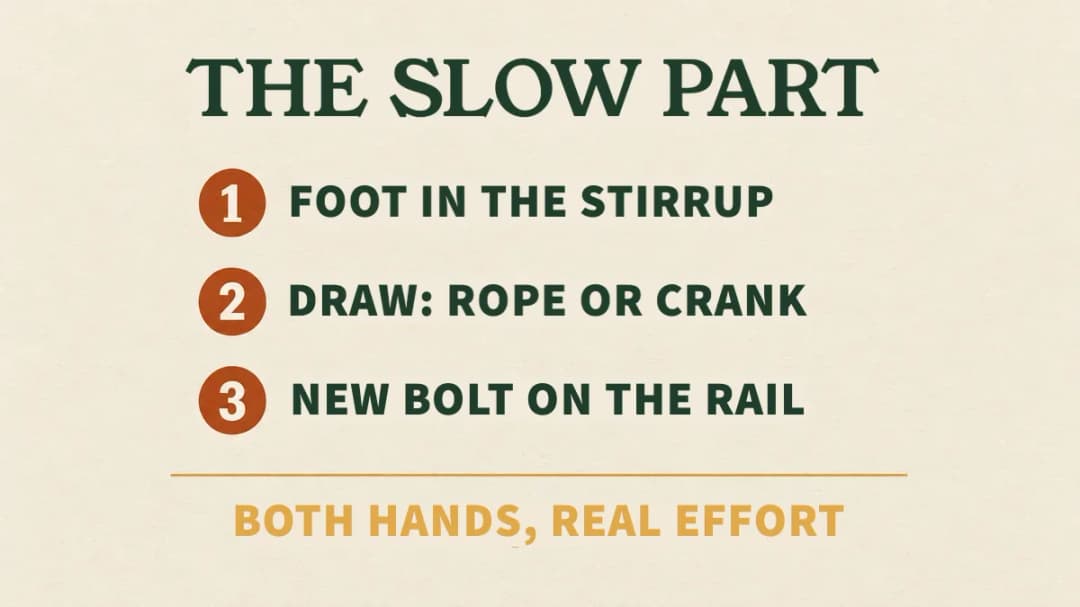
After one shot you have to cock the string, often with your foot in the stirrup and a rope cocker or crank, then load a new bolt. That takes both hands and real effort, and it’s much harder in the dark or under stress.
6. It shouldn’t be stored cocked
TenPoint designs its crossbows to stay cocked through a day of hunting, but recommends de-cocking at the end of each day and never leaving one cocked over 24 hours. Other makers give shorter limits.
So a crossbow kept for defense would usually sit uncocked, which adds the slowest step to the moment you need it most.
7. Overpenetration is real
The old claim that crossbows don’t overpenetrate is wrong. Hunting bolts and broadheads are designed to pass completely through a deer, so a bolt can keep going through a wall into another room.
Read about how crossbow bolts and broadheads are built to penetrate before you believe anyone who says they stop on contact.
8. Intimidation isn’t a plan
Any weapon might make someone think twice, but you can’t plan around how another person reacts. Treat deterrence as a bonus, never as the reason to choose a tool.
Crossbow laws and home defense: what to check first
Crossbows are lightly regulated compared with guns in much of the US. That doesn’t mean there are no rules.
9. Fewer legal restrictions, with limits
Under federal law a firearm is a weapon that fires a projectile by an explosive, so a crossbow isn’t one. State and city laws vary, though, and some restrict where you can carry or shoot a crossbow.
See an example of how one state handles it in my guide to crossbow legal regulations in Ohio.
10. Ease of use and the cool factor
A crossbow is easy to aim with a stock and scope, and owning one is fun. Neither makes it a better home-defense tool, and fun is a reason to take it to the range, not to rely on it at 2 a.m.
I’m a former Marine, and firearms are second nature to me. That background is exactly why I think a crossbow’s one-shot, slow-reload design matters so much here.
I'm a former US Marine. I was in the infantry, let's say 2010 to 14, and I served in Afghanistan, and firearms come second nature to me.
Crossbow safety and storage at home
If you keep a crossbow in the house for any reason, store it like the weapon it is:
- Keep it de-cocked and unloaded, with bolts stored separately.
- Lock it in a case or cabinet away from children.
- Practice regularly with a crossbow-rated target and a safe backstop.
- Inspect the string, cables and limbs on schedule.
| Do | Don’t |
|---|---|
| Store it de-cocked and locked up | Leave it cocked or loaded |
| Check your state and local laws | Assume walls will stop a bolt |
| Practice often and safely | Use damaged bolts |
| Have a home-safety plan beyond any weapon | Rely on intimidation |
Crossbow home defense pros and cons
Put it all together and the balance is clear. Here are the honest pros and cons.
Pros
- Far quieter than a gunshot
- Not a firearm under federal law
- Cheap, reusable practice bolts
- Easy to aim with a stock and scope
Cons
- One shot, then a slow two-handed reload
- Shouldn’t be stored cocked
- Bolts can pass through walls
- Bulky to move with in hallways and doorways
If you learn by watching, this video looks at crossbows for home defense.
Before the FAQ, here are all ten reasons with a one-word verdict each.
// FAQ
Frequently asked questions
Quick answers to the questions readers ask most.
Is a crossbow good for home defense?
Not as your main plan. It’s quiet and easy to aim, but you get one shot, the reload is slow, and it shouldn’t be stored cocked.
Is it legal to use a crossbow for self-defense?
Self-defense law applies the same way whatever the weapon. Check your state’s law or ask a local attorney.
Can you keep a crossbow cocked all the time?
No. TenPoint recommends de-cocking at the end of each day and never leaving it cocked over 24 hours, and some makers give shorter limits.
Will a crossbow bolt go through a wall?
It can. Hunting bolts are built to pass through a deer, so never assume a wall will stop one.
Do you need a license to own a crossbow?
Not under US federal law, because a crossbow isn’t a firearm. Some states and cities have their own rules, so check locally.
Are crossbows quieter than guns?
Yes, much quieter, though a crossbow still makes a sharp crack at the shot.

Final thoughts
A crossbow is quiet, simple and fun to shoot, and it isn’t a firearm under federal law. But one shot, a slow reload and the need to store it uncocked make it a weak primary home-defense plan.
If you own one, enjoy it where it shines: the range and the hunt. Track your practice in the free range log, and store it de-cocked and locked up at home.
