

- There’s no fixed shot count for a crossbow’s life: a well-kept one can last many seasons, while its string and cables wear out first.
- TenPoint recommends replacing the string and cables about every two years.
- Dry fires, bolts under the maker’s minimum weight and leaving the bow cocked are what kill crossbows early.
- Wax, lube and a quick inspection before each session do most of the work.
Ten years? Twenty? Ask how long a crossbow lasts and you’re asking the wrong question. 😉
A crossbow has no set lifespan; its parts do. Replace the string and cables about every two years, avoid dry fires and keep it waxed and lubed, and the bow itself can serve you for many seasons.
What’s the average lifespan of a crossbow? Its parts decide
You’ll see shot counts like “3,000 to 5,000 shots” online, but no manufacturer or standard publishes a lifespan for a whole crossbow. What makers do publish is care and replacement advice for the parts that wear.
| Part | What wears it out | When to act |
|---|---|---|
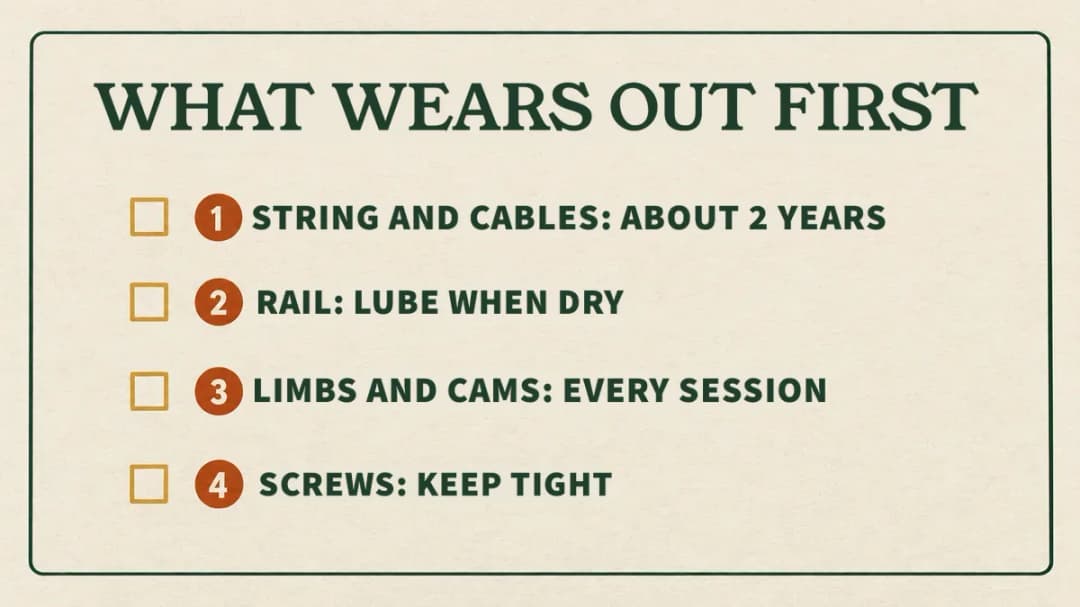
| String and cables | Stretch, fraying, dry serving | Replace about every two years (TenPoint), sooner if damaged |
| Rail and center serving | Friction from the string on every shot | Lube the rail whenever it looks or feels dry |
| Limbs and cams | Dry fires, light bolts, impacts | Inspect each session; stop shooting if cracked |
| Bolts | Hits, misses, cracks | Inspect before every shot |
| Screws and bolts | Vibration | Check they’re tight before each session |
The factors that set how long your crossbow lasts
- How often you shoot: more shots mean more wear on the string, cables and serving.
- Maintenance: waxing, lubing and replacing worn parts on time matters most.
- Build quality: a well-made crossbow from a maker with good support is easier to keep running.
- Handling and storage: knocks, damp and heat shorten its life.
A crossbow also doesn’t need daily practice to stay accurate the way a recurve does. Fewer, better practice sessions mean less wear, as long as you stay sharp at your hunting distances.

// Free printable
Get the range log I actually use.
Seventeen printable pages: session log, score tracker, a 30-day drill challenge, a bow maintenance card, a first-season checklist and more. Join the monthly email and it lands right away.
How often you should maintain your crossbow: a simple schedule

A quick look before each session and a little wax when the string looks dry do most of the work. A dry string is the first thing to fix.
Wax and lube: the cheapest life extension
TenPoint’s guide says to lube the string and cables and wax the bowstring and non-served areas, then rub the wax in. Those few minutes are the cheapest way to extend your crossbow’s life.
The crossbow hunter in Deer & Deer Hunting’s care video (at the end of this post) works a dab of lube along the rail, and explains why the rail matters so much to the string:
You especially want to keep track of this if you’re hunting in dusty and dirty conditions, because if you get a lot of dirt on that rail, that will build up, will cause problems, especially with your string’s life. Shot after shot after shot, it’s going to wear it down. If you keep that clean, you keep it lubricated, you’re going to extend the life of your crossbow.
Clean first, then lube. Lube on a gritty rail just turns the dirt into paste, so wipe the rail down after a dusty or wet hunt, then add the small amount your manual calls for. As he says in the video, you don’t want to overdo it.
For the string, use the wax your manual names, or one made for synthetic bowstrings such as Bohning’s Tex-Tite. Rail lube is a seperate product: use the one your maker sells or names, as in how to use rail lube.

Tex-Tite Wax
Bohning 1306 Tex-Tite Bowstring Wax 1oz, Clear
by Bohning
Affiliate link: I may earn a commission, at no cost to you.
Key features
- String wax made for synthetic bowstrings
- Keeps fibers from drying and fraying, so the string lasts longer
- Stays tacky in heat and cold, so it works year round
- Small 1 oz tube that fits in a quiver pocket
Specs
- Brand
- Bohning
- Model
- 1306
- Size
- 1 Ounce (Pack of 1)
- Color
- Clear
- Length
- 9.8 Inches
- Weight
- 0.05 Pounds
Maintenance schedule
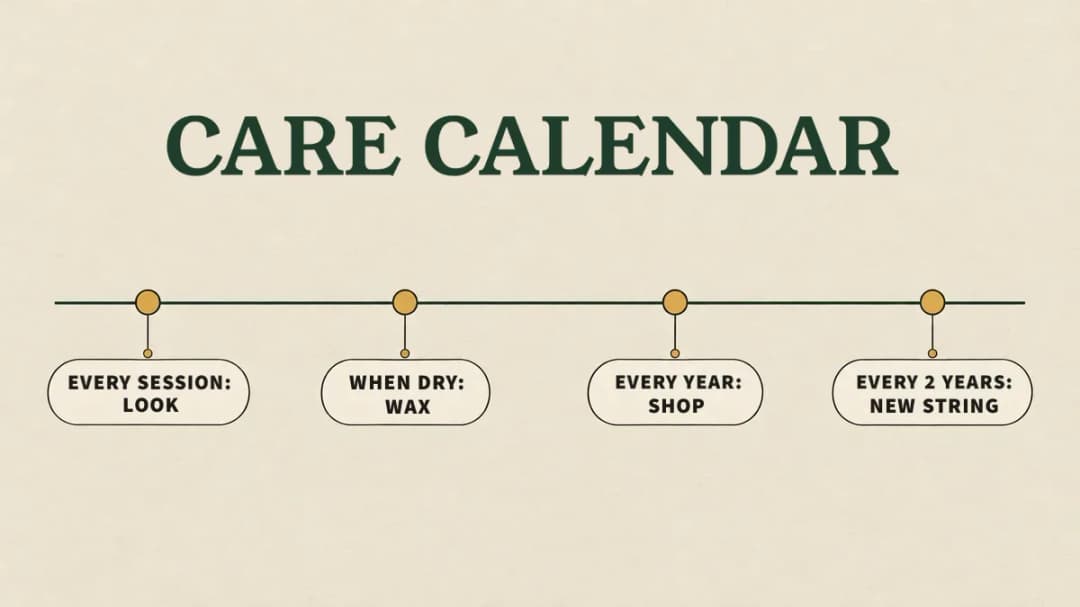
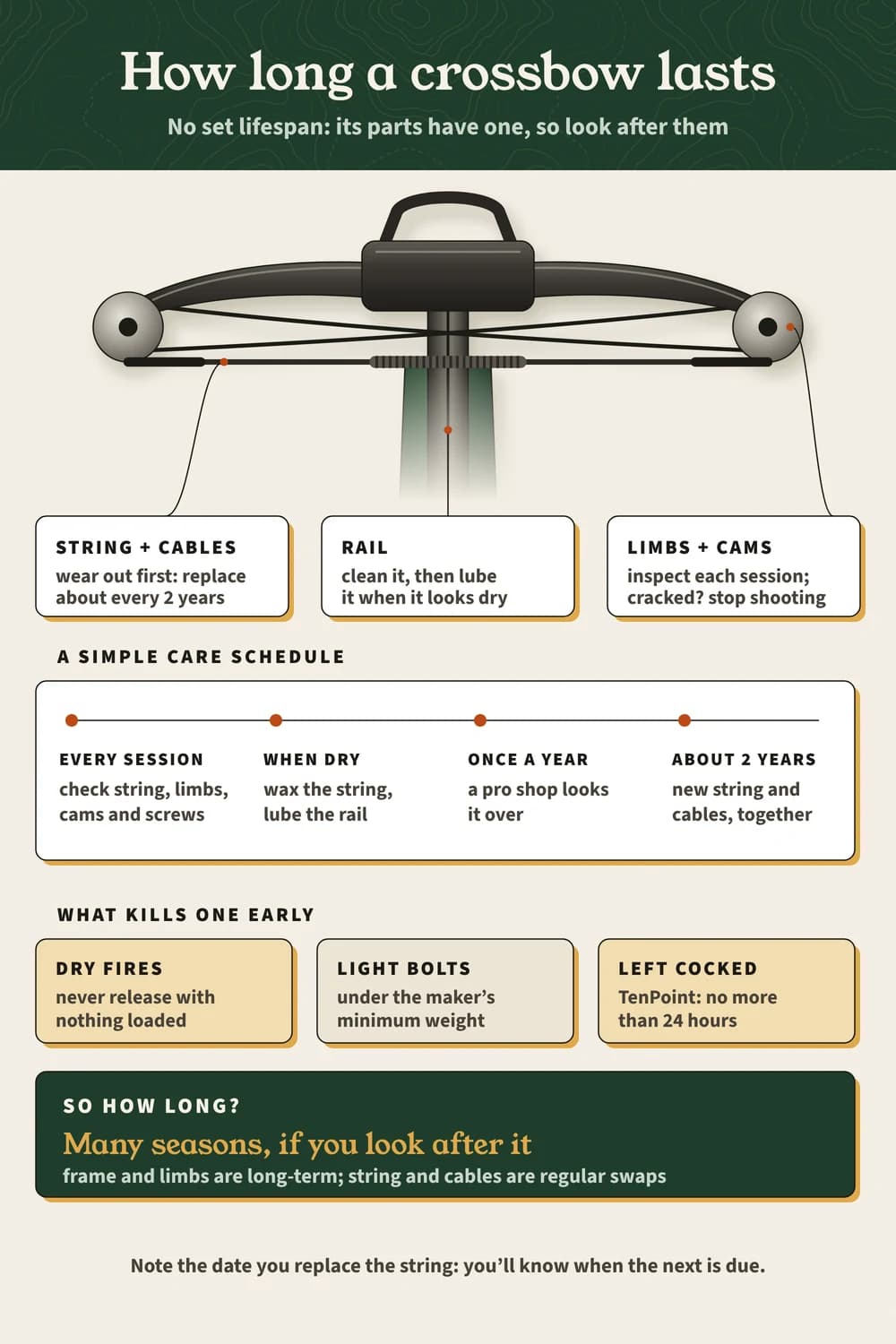
- Before every session: check the string, cables, limbs and cams for fraying or cracks, and make sure screws are tight.
- When dry: wax the string and lube the rail.
- Once a year: have a pro shop look it over before the season.
- About every two years: replace the string and cables together.
In the same video he makes the pro shop step even more pointed for fast, modern crossbows:
If you have a high speed crossbow, modern crossbow, take that to the pro shop at least every other year at the end of the year if you can and have a pro shop tech work on it for you. You’re going to thank yourself later.
He says at least every other year; I’d still aim for once a year, because a shop check costs far less than the limbs or cams it can save. End of season is the smart time too: a shop has time for you then, and anything worn gets fixed before you need the bow.
Moving your crossbow around is part of its life too. See how to transport a crossbow safely.
Crossbow durability: build quality and materials
Two things decide how long the hardware lasts: what it’s made of and how well it’s put together.
Why quality components last longer
Limbs, strings and cams take the load on every shot, so their quality sets your crossbow’s life. Good maker support keeps a bow running, because the parts are there when something wears.
Expensive vs cheap crossbows
Price alone won’t tell you how long a crossbow lasts; parts support will. Before you buy, check that the maker sells replacement strings, cables and limbs for that exact model. Start with the best crossbows.
Does shooting a lot shorten crossbow lifespan?
Shooting more wears the string and cables sooner. But skipped care ages a crossbow faster than practice does.
Training vs casual shooting
Every shot puts stress on the limbs, string and cables. The more you shoot, the sooner wear parts need replacing, so a high-volume shooter should inspect more often.
Finding a shooting balance
Keep your skills sharp without wearing out the bow for no reason. Practice at your real hunting distances, and use a good crossbow target so misses don’t damage bolts.
How stress and draw weight affect your crossbow
Every shot loads the limbs and string. Here’s how that stress adds up.
Fatigue from repeated stress
Like any material under repeated load, crossbow limbs and strings fatigue over time. The higher the stress per shot, the more each shot adds up, which is why manufacturers set limits like minimum bolt weights.
High draw weight and bolt weight
Crossbows store a lot of energy, and the bolt is what carries it away. A bolt lighter than the maker’s minimum leaves more energy in the bow, which can damage it and may void the warranty.
What leads to early crossbow failure
Most crossbows that fail early do so for one of two reasons.
User error
Rough handling, poor storage and skipped maintenance send crossbows to an early grave. Don’t leave it cocked for long: TenPoint advises against more than 24 hours, because the string and cables can stretch.
The costliest user error is a dry fire, and I’ve made it myself with my recurve. It taught me fast that releasing the string with nothing on it can wreck a bow.
That's not what you do with a bow, and I learned that that is a big no-no. I can break the bow, you know.
Manufacturing defects
Sometimes the bow itself is the problem. Buy from a reputable seller and keep your warranty paperwork.
Additional crossbow maintenance tips
A few more habits protect your crossbow for the long haul. Most cost nothing but attention.
- Use a crossbow press to change strings or cables, or have a shop do it.
- Shoot quality crossbow bolts at or above the maker’s minimum weight.
- Store your crossbow uncocked in a cool, dry place.
- Use a cocking aid so the string is drawn evenly every time.
| Do | Don’t |
|---|---|
| Check limb bolts and screws are tight | Dry-fire your crossbow |
| Replace the string and cables about every two years | Let the rail run dry |
| Check limbs and cams for damage | Store it loaded or cocked |
| Follow your manufacturer’s manual | Leave it in damp or extreme heat |
Crossbow hunting pros and cons for long-term owners
Owning a crossbow for years means living with its mechanics. Here’s the trade-off.
Pros
- Steady, accurate aim from the shoulder
- Easier for hunters who can’t draw a vertical bow
- Can extend your season in states that allow crossbows in archery season
- Less practice needed to stay accurate than a traditional bow
Cons
- Heavier and bulkier to carry
- More mechanical parts to maintain
- Strings and cables need regular replacement
- Some hunters find it less challenging than a vertical bow
If you learn better by watching, check out this video titled ‘How to Keep Your Crossbow’.
Pin this one-page care plan where you keep your crossbow, and the next service date never sneaks up on you.
// FAQ
Frequently asked questions
Quick answers to the questions readers ask most.
How many years does a crossbow last?
There’s no set number. With regular care and string and cable changes about every two years, a well-made crossbow can serve for many seasons.
How often should I replace my crossbow string?
TenPoint recommends replacing the string and cables together about every two years. Replace them sooner if you see fraying or a damaged serving.
Can I leave my crossbow cocked overnight?
No. TenPoint advises against leaving a crossbow cocked for more than 24 hours; de-cock at the end of the day by shooting into a target or with an approved de-cocking device.
Does one dry fire ruin a crossbow?
It can damage the string, cables, limbs and cams, and it can hurt you. Have it inspected by a shop before you shoot it again.
How do temperature and weather affect my crossbow?
Damp and extreme heat are hard on strings and limbs, so store your crossbow somewhere dry and stable. Read how temperature affects crossbows before a cold or hot season.
Is it legal to hunt with a crossbow during rifle season?
In some states and seasons, yes. Check your state’s hunting regulations before you go.

Final thoughts
A crossbow doesn’t come with an expiry date. Its life is mostly in your hands: change the string and cables on time, keep it waxed and lubed, and never dry-fire it.
Keep a note of when you replaced the string and how it shoots in the free range log. You’ll always know when the next service is due.
