

- Yes, you can convert most hunting crossbows for bowfishing with a reel, line and fish bolts.
- Aim below the fish: water refraction makes it look higher and closer than it is.
- Use braided bowfishing line (AMS reels ship with 200 lb line), never ordinary fishing line.
- Check your state’s rules first: some states allow crossbows for bowfishing, others don’t.
Deer season is months away. The carp are rolling in the shallows right now. And your crossbow is sitting in its case. 🎣
Good news: you can convert most crossbows for bowfishing with a reel, heavy braided line and barbed fish bolts, as long as your state allows crossbows for it. Set it up right, load each bolt safely, and summer stops being the off season. 😎
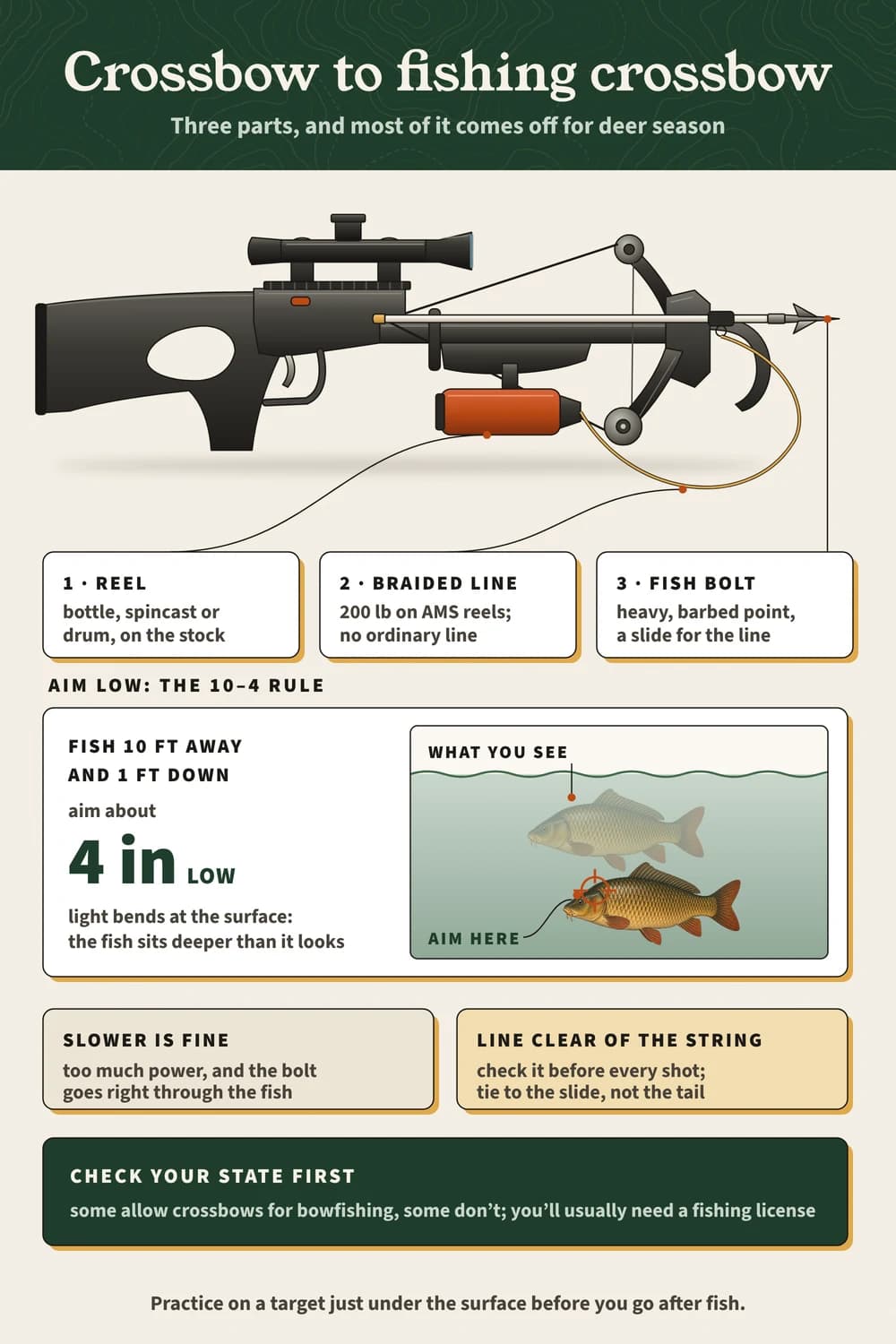
Can you convert a crossbow into a fishing crossbow? Yes, with 3 parts
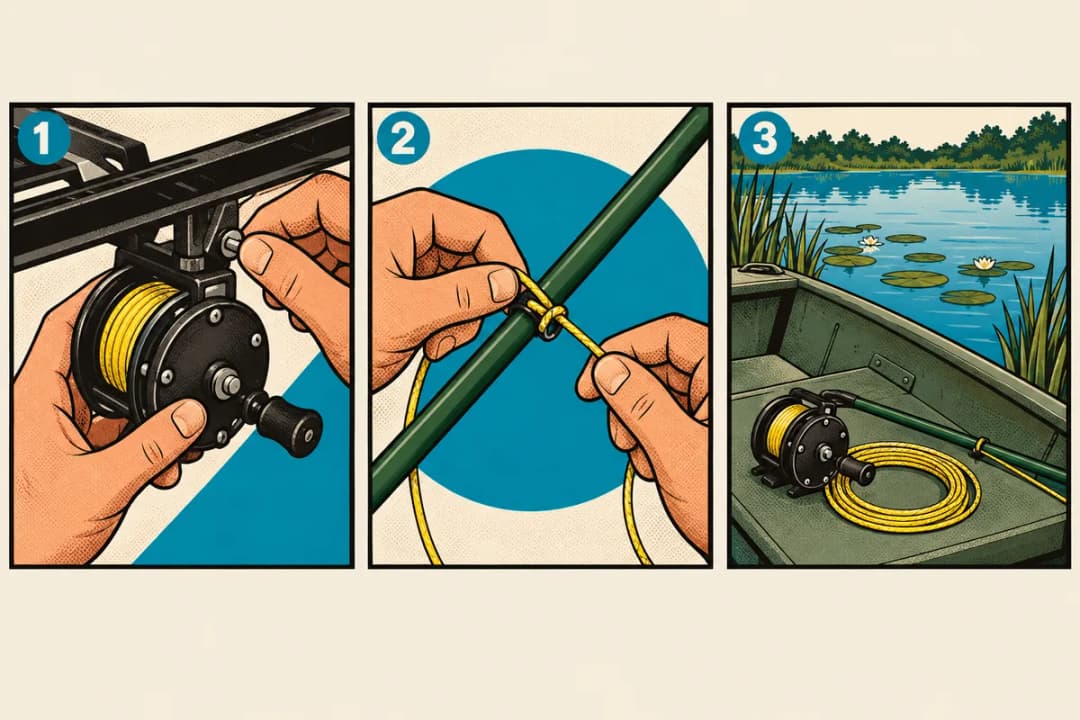
You don’t need a new crossbow. A bowfishing conversion adds a reel, a line and fish bolts to the crossbow you already own, and most of it comes off again in minutes for deer season.
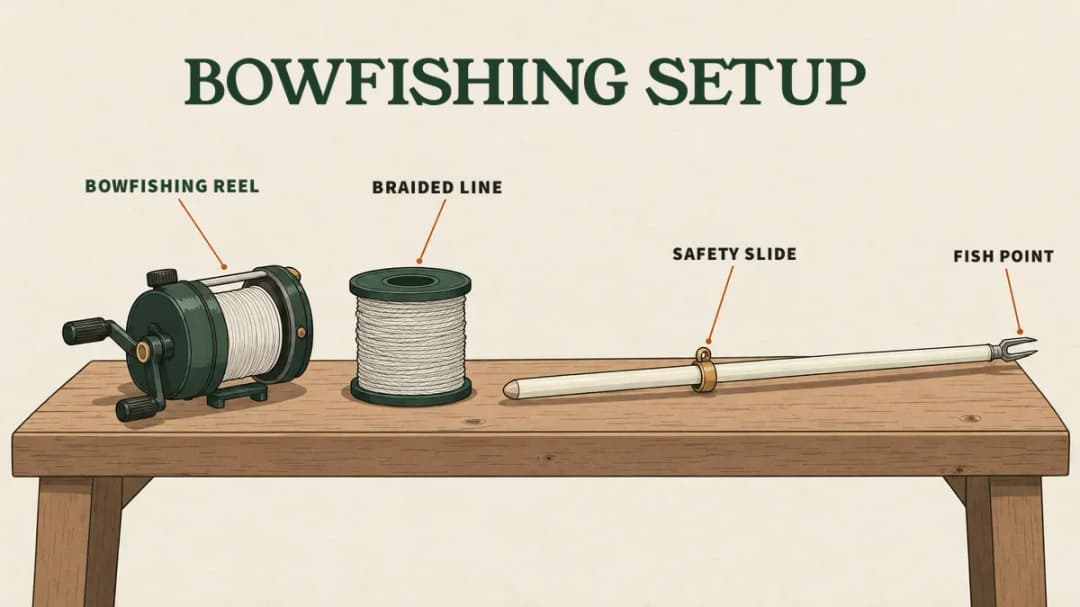
- Fish bolts: heavy bolts with a barbed fish point that holds the fish, and a slide or attachment point for the line.
- A bowfishing reel: a bottle reel, spincast reel or simple drum reel that mounts to the stock or foregrip.
- Bowfishing line: heavy braided line, such as Dacron, tied from the reel to the bolt.
Your crossbow scope still helps, but most fish shots are close and quick. If you haven’t picked a bow yet, start with my list of the best crossbows.

// Free printable
Get the range log I actually use.
Seventeen printable pages: session log, score tracker, a 30-day drill challenge, a bow maintenance card, a first-season checklist and more. Join the monthly email and it lands right away.
Crossbow fishing setup: bolts, reels and line that work together
Each part has one job and they have to match. The bolt must take the line safely, the reel must let line out freely, and the line must be strong enough to haul a fish back.
| Component | What to look for | Why it matters |
|---|---|---|
| Fish bolt | Heavy shaft, barbed fish point, line slide or tie-on point | Holds the fish and keeps line clear of the string |
| Reel | Bottle, spincast or drum reel that mounts on your stock | Lets line pay out with little drag, then reels the fish in |
| Line | Braided bowfishing line (AMS reels come with 200 lb braided Dacron) | Strong enough to land a big carp without snapping |
| Mount | A bracket that fits your crossbow’s stock or accessory holes | Keeps the reel solid and out of the string’s path |
| Aiming | Aim low; start with the 10–4 rule | Corrects for refraction |
Reels: bottle, spincast or drum
Bottle reel: line sits loose inside a bottle and pays out with almost no drag. AMS’s Retriever reels use this design, with 25 yards of 200 lb line.
Spincast reel: a heavy-duty closed-face fishing reel built for bowfishing. It’s familiar if you already fish with a rod.
Drum reel: a simple spool you wrap line around by hand. It’s cheap and almost nothing can go wrong, but it’s slow to bring fish in.
Line: why braid beats monofilament
Ordinary monofilament stretches, twists and tangles. Bowfishing line is heavy braid, and it’s much stronger than the 65 lb line some old guides suggest. Run it through a safety slide on the bolt (AMS ships one with every reel), never tied to the tail of the bolt.
How water refraction affects your aim (and how to correct it)
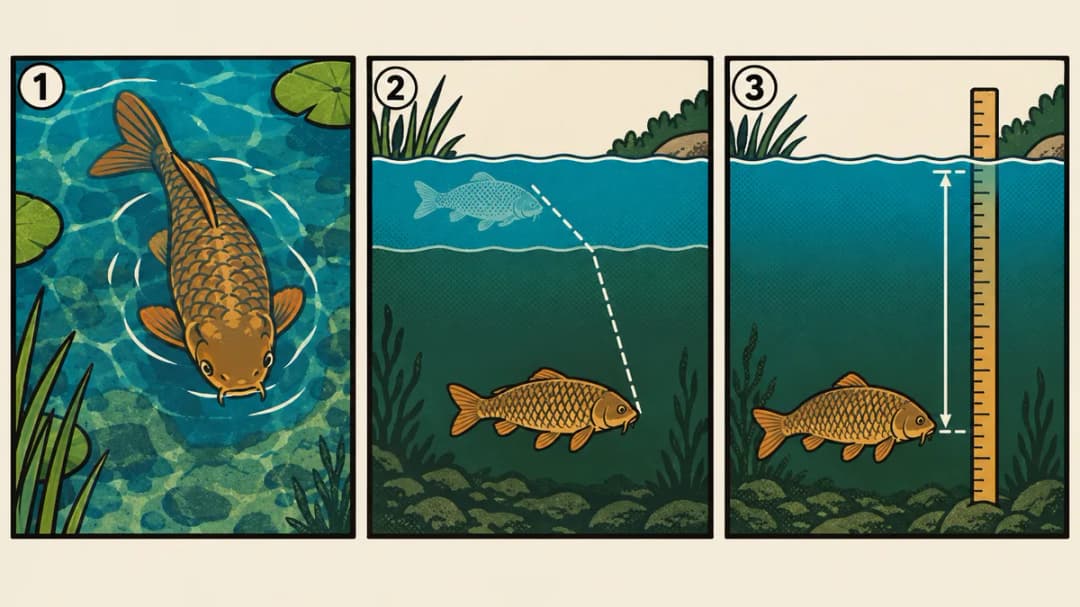
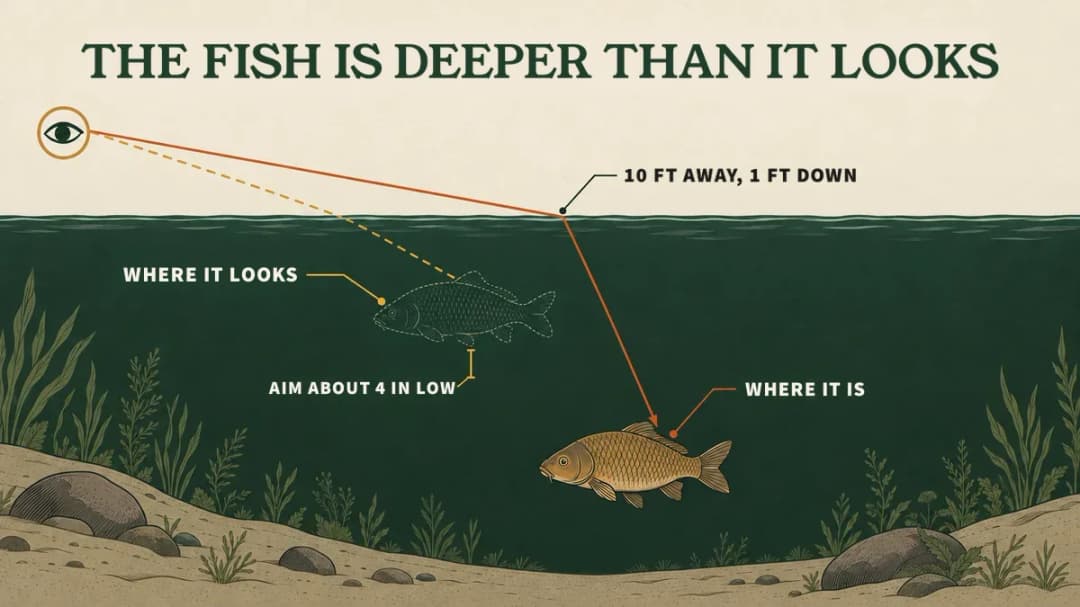
Light bends where it passes from water into air, so a fish always sits deeper than it looks. That’s why most new bowfishers shoot right over the top of thier first fish.
A rule of thumb many bowfishers start with is the 10–4 rule: if a fish is 10 feet away and 1 foot down, aim about 4 inches low. The deeper and farther the fish, the lower you aim, while a shot almost straight down needs little correction.
Austin, who shoots carp with a Barnett recurve crossbow on his Relentless Anglin’ channel (the video near the end of this post), uses the same rule:
So fish is 10 feet in front of you, one foot down, you aim about 4 inches below what you actually see for the fish.
It’s a starting point, not a law. Shoot a few test bolts at a target just under the surface and you’ll learn your own correction faster than any rule can teach it.
Crossbow speed for bowfishing: why more isn’t better
Bowfishing shots are short, the water slows a bolt fast. You don’t need a fast crossbow; you need one you can shoot quickly and safely with a heavy fish bolt.
Austin goes further and says too much power is a problem:
You don’t really want a very powerful crossbow when you’re crossbow fishing, because you don’t want the bolt to just go right through the fish.
That fits how a fish point works: the barbs have to catch inside the fish so the line can bring it back. So don’t buy a faster crossbow for this. The slower one you already own is often the better fishing tool.
Check your crossbow maker’s rules on bolt weight before you shoot heavy fish bolts, because a bolt that’s too light can stress the limbs like a dry fire.
Shooting in summer heat? Read how temperature affects your crossbow before you leave it on a hot boat deck.
Crossbow bowfishing laws: check your state first
This is the step most people skip. Some states allow crossbows for bowfishing, some limit them, and some don’t allow them at all. Rules can also limit which species and waters you can shoot.
- Kansas: crossbows are legal for bowfishing; arrows must have barbed heads and be tied to the bow, and water within 50 yards of an occupied dock, ramp or swimming area is closed.
- Nebraska: crossbows built to be shoulder-fired are legal bowfishing gear, but not for archery paddlefish from Gavins Point Dam down to the U.S. Highway 81 bridge.
- Virginia: crossbows are legal for common carp, goldfish, longnose gar and northern snakehead in public inland waters; bowfin and catfish only in tidal rivers below the fall line, and you must keep what you shoot.
- Everywhere: you’ll usually need a fishing license, and game fish are often off limits.
Crossbow fishing tips for your first trip
- Go for rough fish: common carp, gar, bowfin and buffalo are the usual targets in shallow water.
- Wear polarized glasses: they cut glare so you can see fish under the surface.
- Shoot in good light: clear water and bright sun make fish easier to spot.
- Carry spare bolts and points: rocks and mud chew them up.
- Rinse after saltwater: wipe down the rail, trigger and reel to stop corrosion.
| Do | Don’t |
|---|---|
| Check every line connection before each shot | Ignore local rules on species and seasons |
| Use fish bolts your crossbow maker approves | Shoot with ordinary fishing line |
| Aim below where the fish appears | Shoot with line wrapped around anything |
| Wear eye protection | Handle barbed points without care |
Advantages and disadvantages of crossbow fishing
Crossbow fishing keeps your shooting sharp in the off-season. It’s also extra gear and a new aiming skill, so weigh both sides.
Pros
- Uses the crossbow you already own
- Keeps your shooting sharp between hunting seasons
- Helps clear invasive carp from lakes and rivers
- Easy to hold steady while you wait for a fish
Cons
- Needs a reel, line, mount and fish bolts
- Refraction takes practice to master
- Slower to reload than a vertical bowfishing bow
- Not legal in every state
This video shows a full crossbow fishing setup, if you want to see the parts on a real bow.
Want more gear for the job? Pick up a practice target for sighting in.
Here’s the whole conversion on one page, parts, aim and the legal check, to keep handy before your first carp trip.
// FAQ
Frequently asked questions
Quick answers to the questions readers ask most.
Is crossbow fishing legal?
In some states. Kansas, Nebraska and Virginia allow crossbows for bowfishing, but rules differ elsewhere, so check your state wildlife agency.
What fish can you shoot with a fishing crossbow?
Mostly rough or nongame fish like common carp, gar, bowfin and buffalo. Game fish are usually off limits, and the legal list varies by state (Virginia, for one, limits bowfin and catfish to tidal rivers).
Can you use a fishing crossbow in saltwater?
Yes, where it’s legal, but salt corrodes metal parts fast. Rinse and dry the rail, trigger and reel after every trip.
What line strength do you need for crossbow fishing?
Use braided bowfishing line, not regular fishing line. Popular bowfishing reels like AMS’s come with 200 lb braided Dacron.
Do you need a fishing license to bowfish with a crossbow?
In most states, yes. Bowfishing usually counts as fishing, so a standard license is needed.

Final thoughts
Turning your crossbow into a fishing crossbow is a simple, reversible upgrade: fish bolts, a reel and braided line. Check your state’s rules, aim low, and keep the line clear of the string.
It’s also a great way to keep shooting all summer. Log your sessions in my free range log, so you can see your aim improve before deer season.
