

- A well-maintained crossbow shoots normally across ordinary hunting temperatures, from about 80°F down to −20°F.
- Lubricants and wax are the weak point in the cold: they can thicken and make the trigger or rail sluggish.
- Extreme heat, like a closed car in the sun, can damage limbs and strings.
- Re-check your scope zero and your string after big temperature swings.
Single digits in December, 90°F on the September opener: will your crossbow care? Mostly, no. ❄️
A modern, well-maintained crossbow shoots fine across normal hunting temperatures. What fails is old lube, dry strings and heat in a parked car, and those are all things you can fix before the season. 🔥
How temperature affects crossbows: what changes and what doesn’t
Modern crossbow limbs, strings and bolts are made from fiberglass, carbon and synthetic fibers that handle normal temperature swings well. The parts most likely to give trouble are the lubricants, string wax and plastic or rubber parts, not the limbs.
That’s why maintenance matters more than the thermometer. Crossbows also have more moving parts than vertical bows (a trigger box, safety and often a cocking system), so cold hits them harder through those mechanisms.
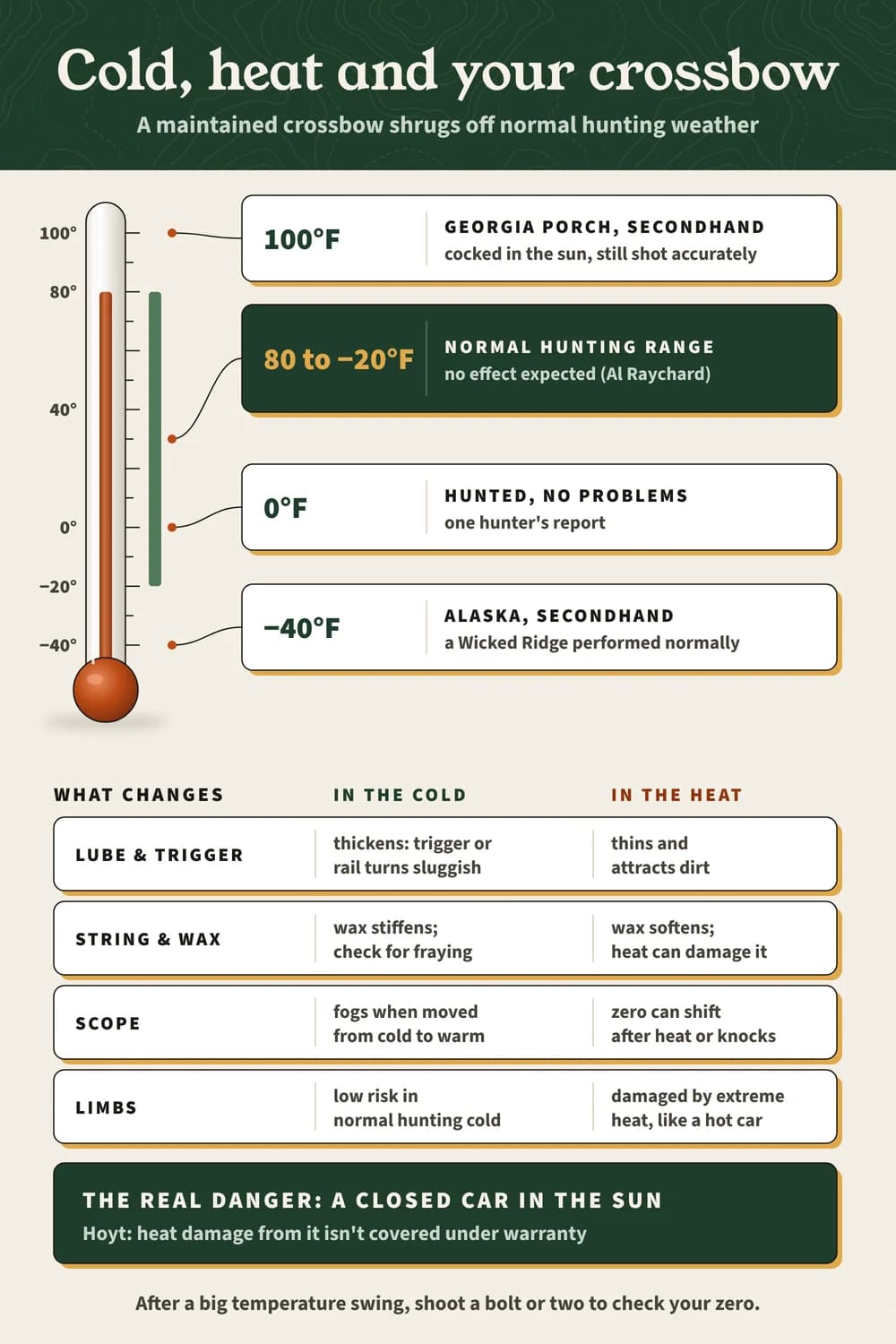
| Part | Cold weather risk | Hot weather risk |
|---|---|---|
| Limbs | Low in normal hunting cold | Can be damaged by extreme heat, like a closed car in the sun |
| String and cables | Wax stiffens; check for fraying | Wax softens; heat can damage the string |
| Rail lube and trigger | Thick lube can make the trigger or rail sluggish | Lube can thin and attract dirt |
| Scope | Fogging when moved from cold to warm | Zero can shift after heat or knocks |
| Plastic and rubber parts | Can turn brittle in severe cold | Can soften or warp |

// Free printable
Get the range log I actually use.
Seventeen printable pages: session log, score tracker, a 30-day drill challenge, a bow maintenance card, a first-season checklist and more. Join the monthly email and it lands right away.
Real-world crossbow performance in extreme cold and heat
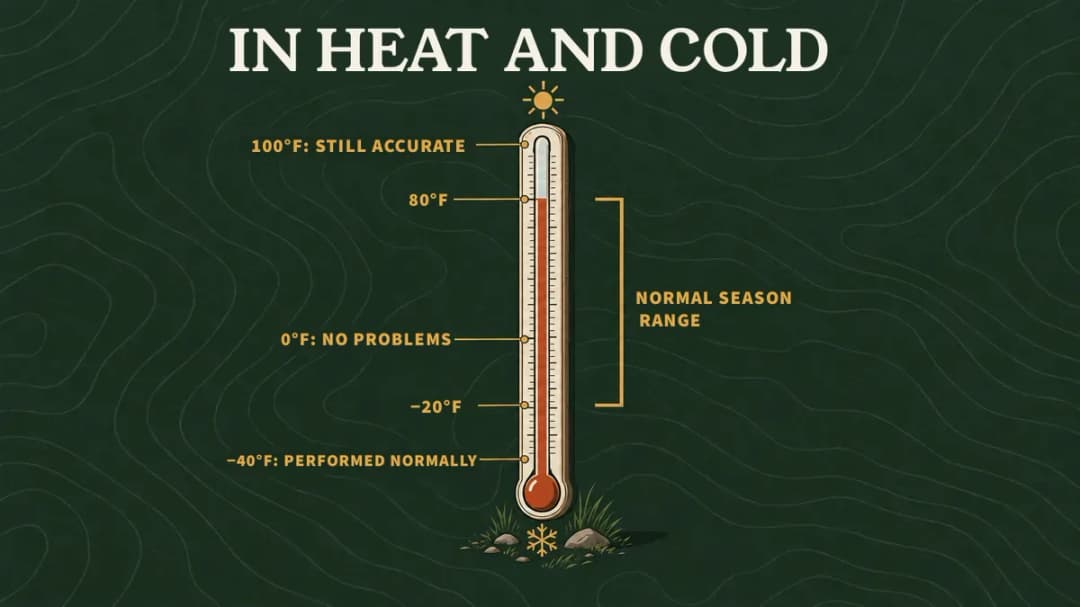
In Deer & Deer Hunting, writer Al Raychard said hunting temperatures from 80°F down to −20°F shouldn’t affect today’s crossbows, and that he’d hunted with them down to 0°F without problems. His conclusion: a properly maintained, lubed crossbow is little affected by heat or cold.
He also passed on two stories from other hunters: a Wicked Ridge crossbow that performed normally at −40°F in Alaska, and a cocked crossbow left on a sunny Georgia porch at 100°F that still shot accurately. Those are secondhand reports. Not lab tests.
A firsthand voice backs him up. The host of Death by Bunjie, who films his crossbow hunts through the Pennsylvania late season (his video closes this post), says this about his own crossbow:
These crossbows in this day and age, most of them are made out of such tremendous awesome materials. This thing performs in my experience just as well in 80°, 90° heat as it does at 0°.
That’s one hunter’s experience, not a test, but it lines up with Raychard. Two people who hunt hard in the cold say the bow isn’t the problem, which points you at the parts that are: lube, wax and the scope.
| Temperature | What was reported | Source type |
|---|---|---|
| 80°F to −20°F | Normal hunting range with no effect expected | Writer’s summary |
| 0°F | Hunted without problems | Writer’s own hunts |
| −40°F (Alaska) | Wicked Ridge crossbow performed normally | Secondhand report |
| 100°F (Georgia porch, in sun) | Cocked crossbow still shot accurately | Secondhand report |
Cold weather crossbow problems: lube, strings and brittle parts
Cold is where maintenance pays off. Metals, lubricants and plastic parts that work fine indoors can fail in severe cold, and a crossbow has more of them than a vertical bow.
The same hunter gives a useful line on where ordinary crossbow oil stops working. Notice he means deep cold here: 20 degrees below zero and colder, the kind he describes for Alaska or Saskatchewan.
Most of those oils will not freeze until you get down well below zero, and I’m talking Fahrenheit here… In those instances you may want to either get special oil or scrap the oil altogether, because that oil can start to gel up.
So for most of us normal oil is fine. In true −20°F cold I’d go with his first option, not the second: ask your maker which cold-weather lube it approves before you run a trigger dry, because the manual knows that trigger better than any of us.
- Wax the string when it looks fuzzy or feels dry, and rub the wax in.
- Lube the rail after rain or snow, so water doesn’t rust or lock up the trigger box.
- Check the cocking device: rope cockers and cranks have cords and parts that stiffen in the cold.
- Carry spare batteries for an illuminated scope; batteries fade fast in the cold.
Winter gloves and crossbow safety: keep fingers below the rail
Cold hands are clumsy hands, and that matters more on a crossbow than a vertical bow. The string travels along the rail, so anything above it is in the way.
Hot weather risks: why a parked car is the real danger
Hunting in heat is rarely the problem. Leaving your crossbow in a closed car on a sunny day is: Hoyt warns that heat in a closed vehicle can cause component failure in its bows, and damage from extreme exposure isn’t covered under warranty.
Keep your crossbow out of a hot trunk or back window, and take it inside when you stop. In the field, keep it in the shade, and don’t leave it cocked for hours. My guide on how long you can leave a crossbow cocked covers why.
Temperature swings and your scope zero
Moving between a warm truck and freezing air can fog lenses and loosen poorly tightened mounts. Shoot one or two practice bolts at a known distance before the hunt, so you know your zero still holds.
When you bring a cold crossbow inside, leave it in it’s case for a while. That lets it warm slowly and keeps condensation off the scope and trigger.
One fogging cause has nothing to do with the crossbow at all. The Death by Bunjie host wears a face mask in the cold, and warns about this:
Don’t pull it up over your nose if you’re looking through that scope. When you go to look through the scope, when you’re breathing out, the heat from your breath is going to rise right up out of that, out of that mask and it’s going to hit that scope and fog it up instantly.
It’s a small detail that can cost you the one shot of the day. Keep your breath below the scope: mask under your nose, and breathe out away from the eyepiece as you settle in.
Additional crossbow maintenance tips
A simple routine keeps your crossbow ready for any temperature. Do it before the season and again before any big weather change.
- Store your crossbow uncocked in a cool, dry place.
- Inspect the string, cables, limbs and bolts for wear before every hunt.
- Lubricate with the products your crossbow maker recommends.
- Tighten scope rings and accessory screws.
| Do | Don’t |
|---|---|
| Lube the rail and trigger with the maker’s recommended products | Leave your crossbow in a closed car on a sunny day |
| Wax the string when it looks dry or fuzzy | Store it wet after a rainy or snowy hunt |
| Check your zero after big temperature swings | Use lubricants your maker doesn’t recommend |
Choosing a new crossbow? My list of the best crossbows covers models built for hard use.
Advantages and disadvantages of crossbow hunting in harsh weather
Bad weather can be great hunting. A crossbow has a few real advantages when it’s cold, and a few drawbacks.
Pros
- No need to draw and hold with stiff, cold muscles
- A scope helps in poor late-season light
- Stays accurate across normal hunting temperatures when maintained
Cons
- More moving parts that cold lube can slow down
- Heavier to carry in deep snow
- Slower to reload with gloves on
This video shows how to hunt with a crossbow when the weather turns bad.
If you'd rather see it than read it, this one-page chart sums up what cold and heat do to a crossbow.
// FAQ
Frequently asked questions
Quick answers to the questions readers ask most.
Does cold weather affect crossbow accuracy?
Not much, if the crossbow is maintained. Hunters report normal shooting down to −20°F and below; the bigger risks are thick lube, a dry string and a scope that fogs or shifts.
Can you leave a crossbow in a hot car?
No. Heat in a closed car on a sunny day can damage limbs and other components, and bow makers like Hoyt don’t cover that damage under warranty.
Can crossbow strings snap in cold weather?
A healthy, waxed string is very unlikely to snap from cold alone. Inspect it for fraying before cold hunts, and replace it if you see damage.
Can temperature swings change my scope’s zero?
They can, especially if the mounts are loose or the scope fogs. Shoot a practice bolt at a known distance before you hunt.
What lube should I use on a crossbow in winter?
Use the rail lube your crossbow maker recommends. Several brands sell lubes marketed for cold weather that don’t gum up.

Final thoughts
Temperature rarely beats a well-maintained crossbow. What causes trouble is thick lube in the cold, a dry string and heat in a parked car.
Lube it, wax it, keep it out of hot cars and check your zero after big swings. Then log your cold-weather practice in my free range log, so you know your crossbow is ready before the hunt.
