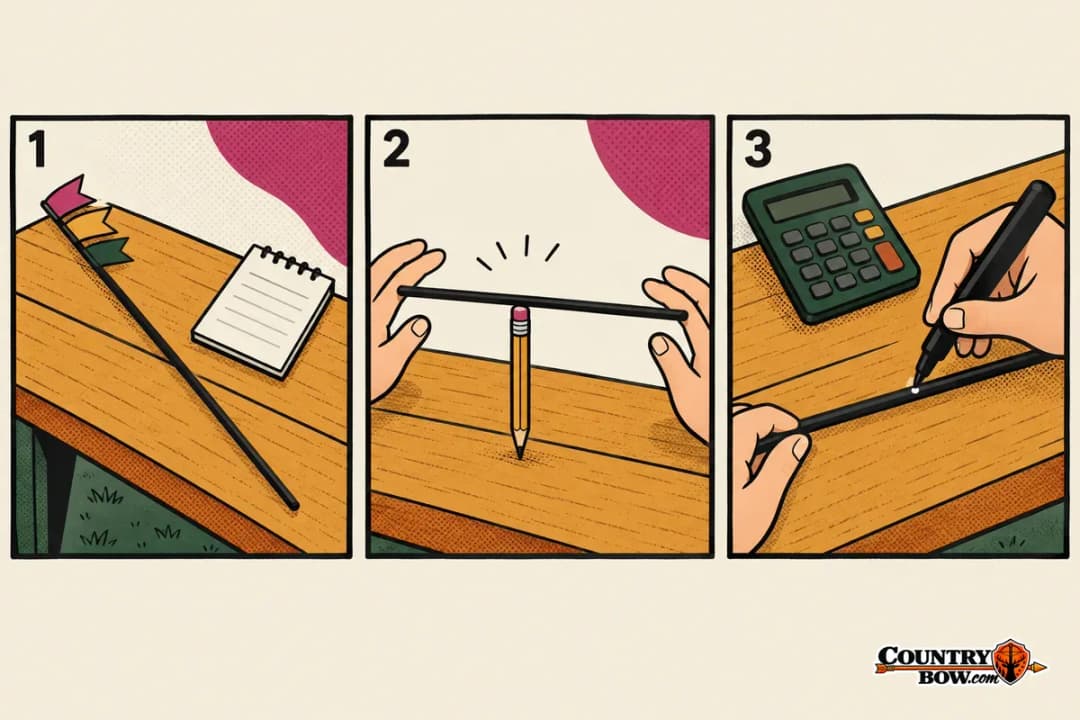


- FOC (front of center) shows how far a bolt’s balance point sits ahead of its middle, as a percentage of its length.
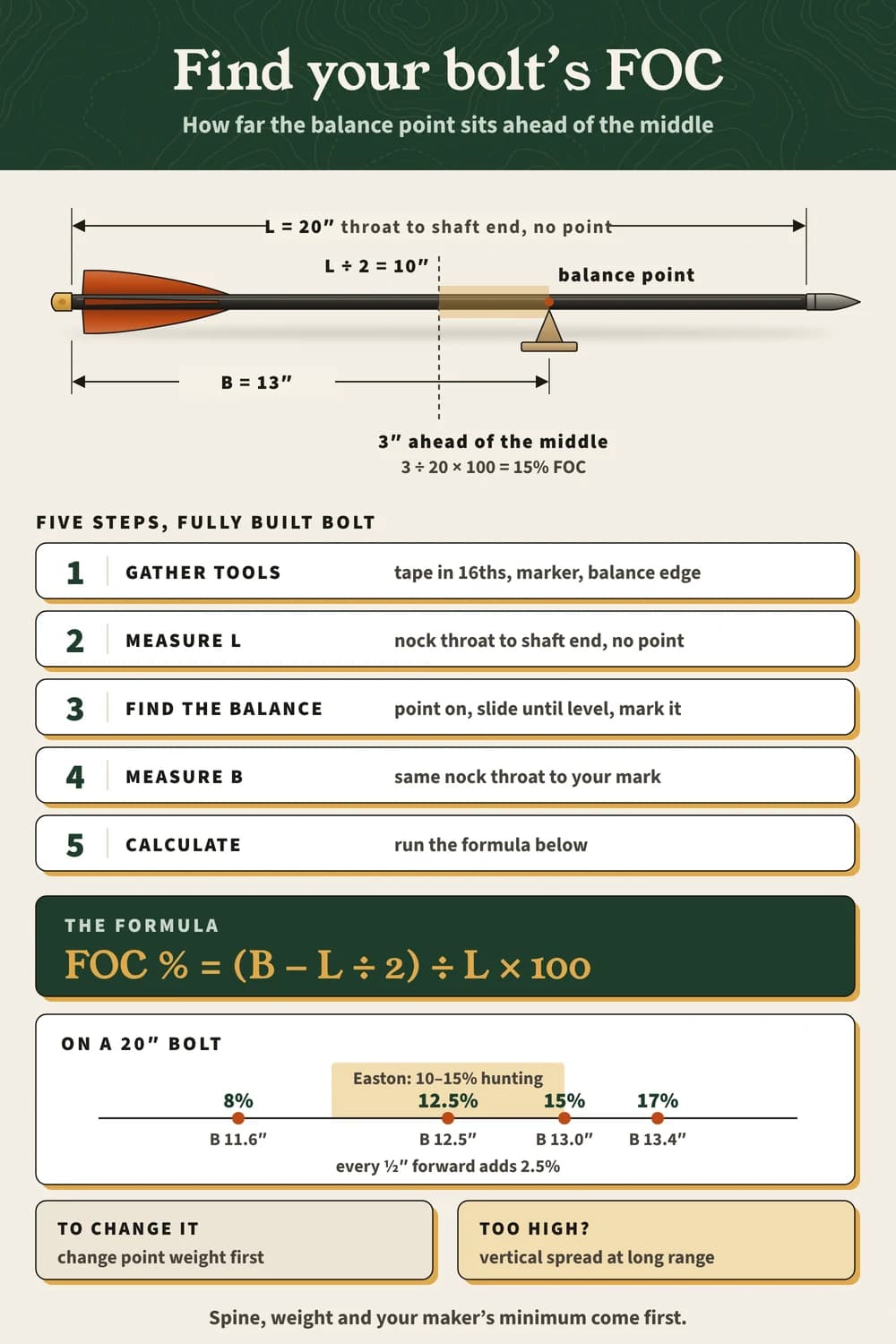
- The formula is FOC % = (balance point − length ÷ 2) ÷ length × 100, measured from the throat of the nock.
- Measure the length without the point (nock throat to the end of the shaft), but balance the bolt with the point on.
- Easton recommends 10–15% FOC for hunting, and TenPoint lists its EVO-X bolts at about 15.5–17%.
- Spine, weight and your crossbow’s minimums come first; FOC is the fine-tuning after them, and point weight is the first thing to change.
Want the number without the math? Use the FOC calculator and enter your length and balance point, or estimate it from your point, insert and vanes.
New bolts or a new point, and suddenly your groups open up at 40 yards, and where the weight sits might be why. 🤔
You can find FOC in five steps: measure the bolt, find its balance point with the point on, and run one simple formula. Then tune on purpose, starting with the right bolt weight for hunting.
What FOC means and why it matters for crossbow bolts
FOC stands for front of center. It tells you how much of a bolt’s weight sits toward the point. A bolt with more weight up front tends to fly point-first and stay stable, much like a dart.
FOC isn’t a law or a rating. Just a measurement. It’s most useful when you compare setups, such as a 100-grain field point against a heavier broadhead on the same bolt.
- Raise FOC with a heavier point, broadhead or insert.
- Lower FOC with a lighter point or a heavier nock and vanes.
- Total weight is separate: a heavy bolt can still have a low FOC if the weight is spread out.
The bowhunter behind the Bowhunt or Die video in the next section has the simplest way to picture it:
Think about it this way: the more weight you add to the front of your arrow, the farther in front of the center point the balancing point is going to be, thus the higher percentage of FOC you are going to have.
That one sentence is the whole idea. Weight up front moves the balance point forward, and FOC is just that distance as a percentage, which is why the point is the first thing to change when you tune.

// Free printable
Get the range log I actually use.
Seventeen printable pages: session log, score tracker, a 30-day drill challenge, a bow maintenance card, a first-season checklist and more. Join the monthly email and it lands right away.
How to calculate the FOC of your crossbow bolts in 5 steps
All you need is a tape measure, a fine-point marker and something to balance the bolt on. Use a fully built bolt: nock, vanes, insert and the point you’ll actually shoot.
Prefer to watch? ‘What Is Arrow FOC And How To Measure It’ walks through the same measurement on an arrow.
Step 1: Gather your tools
Grab a tape measure that reads in sixteenths, a marker and a balance edge. A purpose-made balance jig is more precise, but a finger or a thin ruler edge works.
In the video he skips the jig entirely, because FOC only needs a round number:
You don’t have to be exact to the sixteenth of an inch. So for me personally, I usually just use my finger.
I agree. What matters is measuring the same way every time, so when you swap a point or an insert the change you see is real and not your finger moving.
Step 2: Measure the bolt length
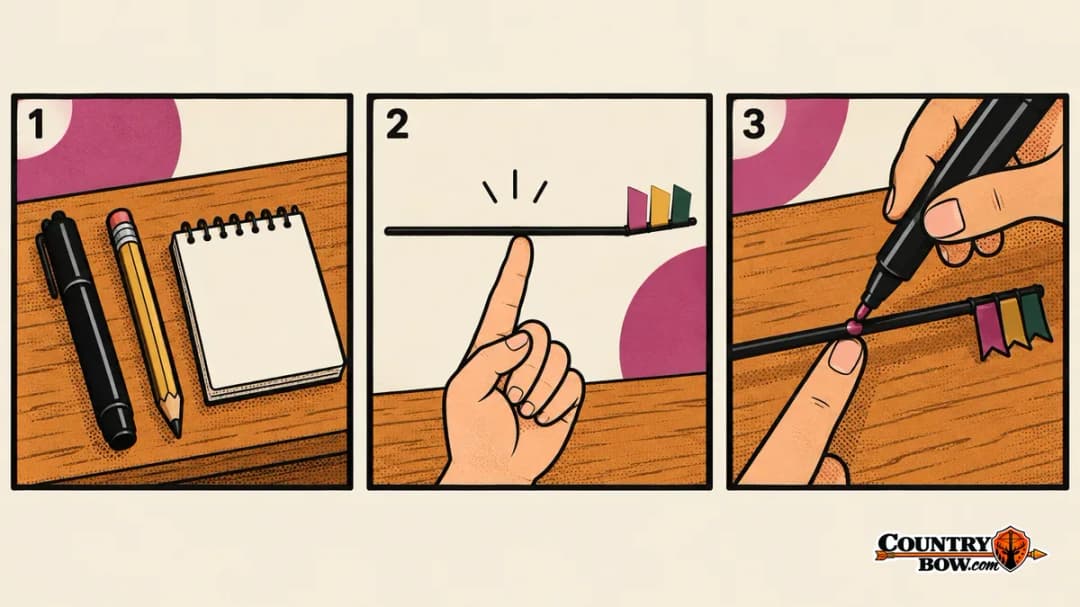
Measure from the throat of the nock, where the string sits, to the end of the shaft. Do not include the point or the part of the insert that sticks out. This is your length, L.
Step 3: Find the balance point
With the point screwed in, slide the bolt accross your balance edge until it sits level. Mark that spot clearly, because every number after this depends on it.
Step 4: Measure from the nock to the balance point
Measure from the same nock throat to your mark, this is the balance point distance, B.
Step 5: Calculate your FOC percentage
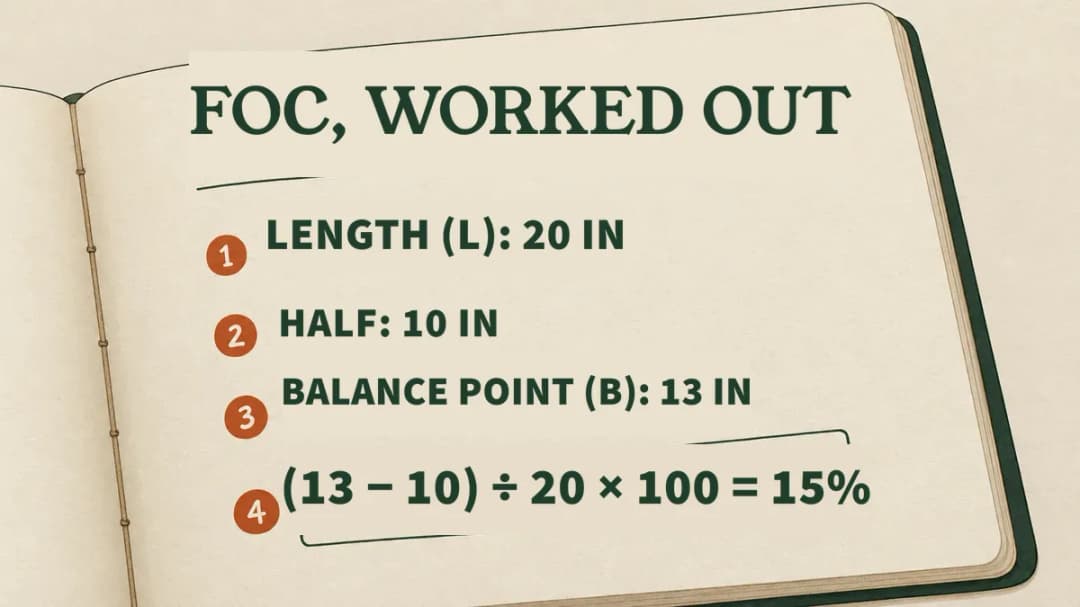
Divide L by 2, subtract that from B, divide by L and multiply by 100. FOC % = (B − L ÷ 2) ÷ L × 100. Online FOC calculators, such as the one on Lancaster Archery’s site, do the same math.
FOC examples for a 20-inch crossbow bolt
Here’s how the balance point changes FOC on a 20″ bolt, where half the length is 10″. Every half inch the balance point moves forward adds 2.5% FOC.
| Bolt length (L) | Balance point from nock (B) | FOC |
|---|---|---|
| 20″ | 11.6″ | 8% |
| 20″ | 12.5″ | 12.5% |
| 20″ | 13.0″ | 15% |
| 20″ | 13.4″ | 17% |
For context, Easton recommends 10–15% FOC for hunting arrows. TenPoint lists its EVO-X CenterPunch bolts at about 17%, with some retailers listing 15.5%, so many factory crossbow bolts land at the high end of that range or just above it.
How to adjust FOC: tips for tuning your bolts
- Change point weight first: it’s the easiest and cheapest way to move FOC.
- Match broadheads to field points: same weight means the same FOC and the same impact point. Browse the best broadheads by weight.
- Stay above your minimum: any change must keep the finished bolt above your crossbow’s minimum weight. See my guide to bolt weight for hunting.
- Keep a record: write down each setup, its FOC and how it grouped.
- Test on a target: shoot each change on a good crossbow target before you trust it.
Pros and cons of tuning FOC
Measuring FOC takes a few minutes and a scale. Here’s what that effort gets you, and what it doesn’t.
Pros
- More stable flight, especially with broadheads
- Can help penetration on game
- Gives you a number to compare setups
- Helps you spot a bolt that’s built differently
Cons
- Too much FOC can cause vertical spread at long range, per Easton
- Heavier points slow the bolt and add drop
- Easy to obsess over FOC and ignore spine and weight
- Buying heavier points and inserts costs money
Researchers have studied it too. Dr. Ed Ashby’s Arrow Lethality Study, hosted by Colorado Parks and Wildlife, tested arrow mass and FOC on large game, and it’s a big reason hunters talk about FOC today.
The same video points out what high FOC really buys you, and it isn’t only balance:
By adding more weight to the front of your arrow and increasing your FOC, you are inherently increasing the overall weight of the arrow, which is going to increase kinetic energy and momentum, which are both factors in penetration.
That’s the catch hiding in a lot of FOC talk. Part of the benefit comes from the extra weight, not the percentage itself. He’s talking about vertical-bow arrows, and on a crossbow the same weight also changes your drop, so re-sight after every change and stay inside your maker’s weight limits.
Keep this one-page version of the method next to your tape measure the first time you balance a bolt.
// FAQ
Frequently asked questions
Quick answers to the questions readers ask most.
What is a good FOC for crossbow bolts?
Easton recommends 10–15% for hunting arrows, and factory crossbow bolts such as TenPoint’s EVO-X are listed around 15.5–17%. Pick what groups best from your crossbow within your maker’s weight rules.
How much does bolt length affect FOC?
A lot, because FOC is a percentage of length. The same point on a longer bolt gives a different FOC, so always measure the bolt you shoot.
Does changing broadhead weight change FOC?
Yes. A heavier broadhead moves the balance point forward and raises FOC, so choose broadheads with your FOC goal in mind.
Can FOC be too high?
Yes. Easton notes that greatly exceeding the recommended range can cause vertical spread at longer distances, especially with lighter arrows.
Do I include the point when measuring bolt length?
No. Measure from the nock throat to the end of the shaft, then put the point on to find the balance point.

Final thoughts
Finding your FOC takes five minutes and a tape measure. Measure the length without the point, balance it with the point on and run the formula.
Then shoot each setup and keep notes on how it grouped; my free range log makes that easy. My best bolts guide lists bolts with published FOC figures, and if you’re still choosing the bow itself, compare crossbows first.
