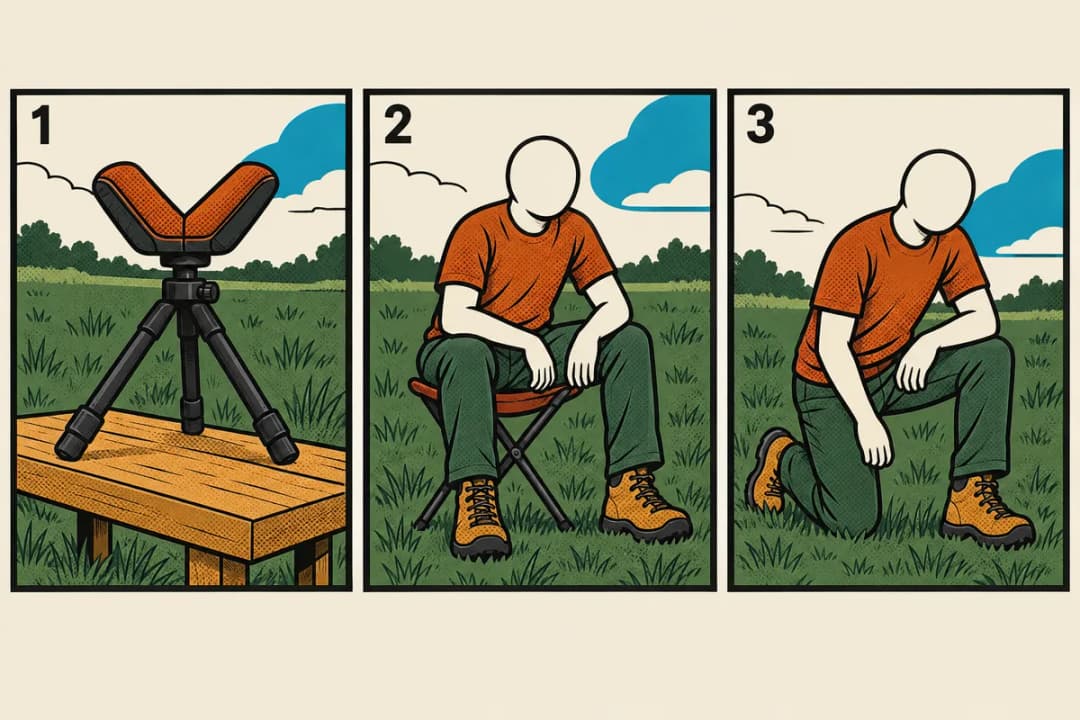


- Rest the crossbow whenever you can: a supported shot beats any unsupported position.
- From steadiest to shakiest: bench or tripod, prone, sitting, kneeling, standing.
- In every position, nothing may touch the limbs or sit in their path: not a rest, a tree, a window frame or your knee.
- Practice from the position you’ll hunt in, at the height you’ll hunt from, before the season starts.
Why does a crossbow that groups tight off the bench fall apart the second you crouch behind brush? 🤔 It isn’t the bow. It’s the hold.
The rule is simple: support the crossbow every time you can, and practice the few positions you’ll really shoot from, set up the same way each time. Learn the five below, keep the limbs clear, and pair them with a season of training your hold. 💪
Crossbow shooting positions ranked from steadiest to shakiest
A crossbow is heavier than most vertical bows, and you hold its full weight up the whole time you aim. The more of you that touches the ground or a rest, the less the crosshair moves.
| Position | Steadiness | Time to set up | Best for | Watch out for |
|---|---|---|---|---|
| Bench or tripod rest | Highest | Slow (set up ahead) | Sighting in, blinds, practice | A rest under the limbs |
| Prone | Very high | Slow | Open ground, long practice shots | Limbs and string near the ground |
| Sitting (knees up or sticks) | High | Medium | Ground blinds, sitting against a tree | Elbows on kneecaps |
| Kneeling | Medium | Fast | Waist-high cover, stalking | Holding it too long |
| Standing (offhand) | Lowest | Fastest | Short, quick shots only | Wind and fatigue |
Hunter education courses rank rifle positions the same way, prone the most accurate and standing the least. The same order holds for a crossbow, which is aimed and fired from the shoulder like a rifle.
// Free printable
Get the range log I actually use.
Seventeen printable pages: session log, score tracker, a 30-day drill challenge, a bow maintenance card, a first-season checklist and more. Join the monthly email and it lands right away.
Limb clearance: the one rule for every crossbow position
When a crossbow fires, it’s limbs (and cams, on a compound crossbow) snap forward to their resting position. Anything in that sweep gets hit at full force, and the limbs, string or the object can break.
- Rest the crossbow on the forend of the stock, behind the limbs, never on the limbs or the riser in front of them.
- In a blind, keep the limbs inside or fully outside the window, never against its frame.
- In a treestand, clear twigs from the limbs’ path at every spot you might shoot.
- Keep your support hand’s fingers and thumb below the rail, as when loading a bolt safely.
1. Bench or tripod rest: the steadiest crossbow position
A shooting bench, sandbags or a tripod rest holds the crossbow so your muscles don’t have to. It’s the position to sight in from and the steadiest one for a ground blind.
Death by Bunjie, a long-running crossbow hunting channel, answered a viewer asking whether to hunt with a support at all:
I say categorically yes. If you could support your crossbow, you’re a step ahead of the game.
That’s the stance of this whole post. A rest isn’t a crutch; it’s the steadiest tool you own, and he goes on to use a tripod for sighting in, a stand’s shooting rail, shooting sticks and his own knee.
To set up a rest well:
- Put the support under the forend of the stock, and level the tripod if it has a bubble.
- Pull the stock into the pocket of your shoulder, with your cheek in the same spot on the stock every time.
- Keep a hand on the front grip even on a tripod; a reverse-draw crossbow especially can jump on the shot.
Sighting in a new scope? Do it from this position: the full method is in how to sight in a crossbow scope.
2. Sitting: the crossbow position most hunts happen in
Many crossbow shots at deer come from a seat: a blind chair, a stand, or the ground with your back to a tree. Sitting with support for both elbows is close to bench-steady, and you can hold it for a long time.
- Sit facing slightly off the target line, knees up, feet flat.
- Rest your elbows on the muscle above each knee, not the kneecap; bone on bone wobbles.
- If there’s a tree, put your back against it for a third point of support.
- Better still, rest the forend on shooting sticks or a bipod set at the right height before the deer arrives.
Dan Schmidt of Deer & Deer Hunting uses sticks on almost every crossbow sit. His opening line settles the debate:
The question should not be whether or not you should use shooting sticks when you’re hunting with a crossbow. It should be what type are you most comfortable with.
A monopod, bipod or tripod all work, pick the one you’ll actually carry. Whatever you choose, set its height for your seat ahead of time, because a deer won’t wait while you adjust legs.
He also explains how he holds the crossbow on the sticks once it’s there:
When shooting off of any type of sticks, you want three points of contact. Number one, the crossbow solidly on, in this case, the bipod… the stock of the crossbow tightly into the crease of my shoulder and then my hand underneath it.
Three points of contact is the right test for any rest. Sticks, shoulder and a hand pulling down and back lock the crossbow in place; if one is missing, the crosshair dances.
3. Kneeling: fast, and low enough for brush
Kneeling gets you steadier than standing in a few seconds and it keeps your head below waist-high cover. It’s the stalking and still-hunting position.
- Put the knee on your trigger-hand side on the ground and sit back on that heel.
- Bring the other knee up and rest your support elbow on the muscle just above it, not on the kneecap.
- Keep the crossbow level: kneeling on a slope makes it easy to tilt (cant) the limbs.
Kneeling with shooting sticks is steadier still. It’s tiring to hold for long, so get into it when the shot is coming, not an hour early.
4. Prone: the steadiest without a rest, rarely practical
Lying flat behind the crossbow is the most stable unsupported position. In the woods it’s rarely usable: grass and brush block the view, and the limbs and string need clear space above the ground.
If you do shoot prone, raise the forend on a pack so the limbs and cams can’t touch the ground. Most crossbows are cocked with a foot in the stirrup, so you’ll break position to reload.
5. Standing offhand: a last resort for short shots
Standing is the fastest position and the shakiest. Save it for close, quick shots, and shorten the distance if you can’t rest the crossbow.
- Feet about shoulder-width apart, the front foot pointed at the target and the front knee slightly bent.
- Support hand on the forend, pulling the stock back into your shoulder; trigger hand relaxed.
- Trigger-side elbow fairly close to your body; a sling wrapped around the support arm adds tension and steadiness.
- Squeeze the trigger and keep aiming until the bolt hits.
Firearms come second nature to me from my years as a Marine infantryman, and the rifle rule carries straight over: support beats strength. I shoot a recurve, not a crossbow, so the crossbow specifics here come from makers, hunter education and long-time crossbow hunters.
Shooting a crossbow from a treestand or a ground blind
Elevated and enclosed spots add their own rules. Set up and practice at the real height and in the real blind before the season, so the first shot isn’t the first try.
- Use the shooting rail as your rest, padded so the forend doesn’t clank, with the limbs clear of the rail.
- Bend at the waist for downhill shots, keeping your upper body and the crossbow in the same shape as on the ground.
- Clear the limbs’ path at every angle you might shoot, even if it costs a little cover.
- In a ground blind, sit back from the window, keep the limbs inside it and rest on sticks or a tripod.
Keep your shots inside the distance you can group from that seat. The ethical shot checker helps you decide when to take one.
A practice plan for each crossbow position
Positions only help if they’re automatic. Spend most practice time on the one or two positions you’ll really hunt from.
- Start each session with one group off the bench, to confirm the zero.
- Shoot a group from your main hunting position (usually sitting with sticks) at 20 yards.
- Repeat it at your longest planned distance.
- Finish with a few shots from a backup position, like kneeling or standing, at short range.
- Write down the group size for each position, so you know your real limits.
If your groups are big from every position, the problem may not be your hold. Work through the crossbow accuracy fixes next.
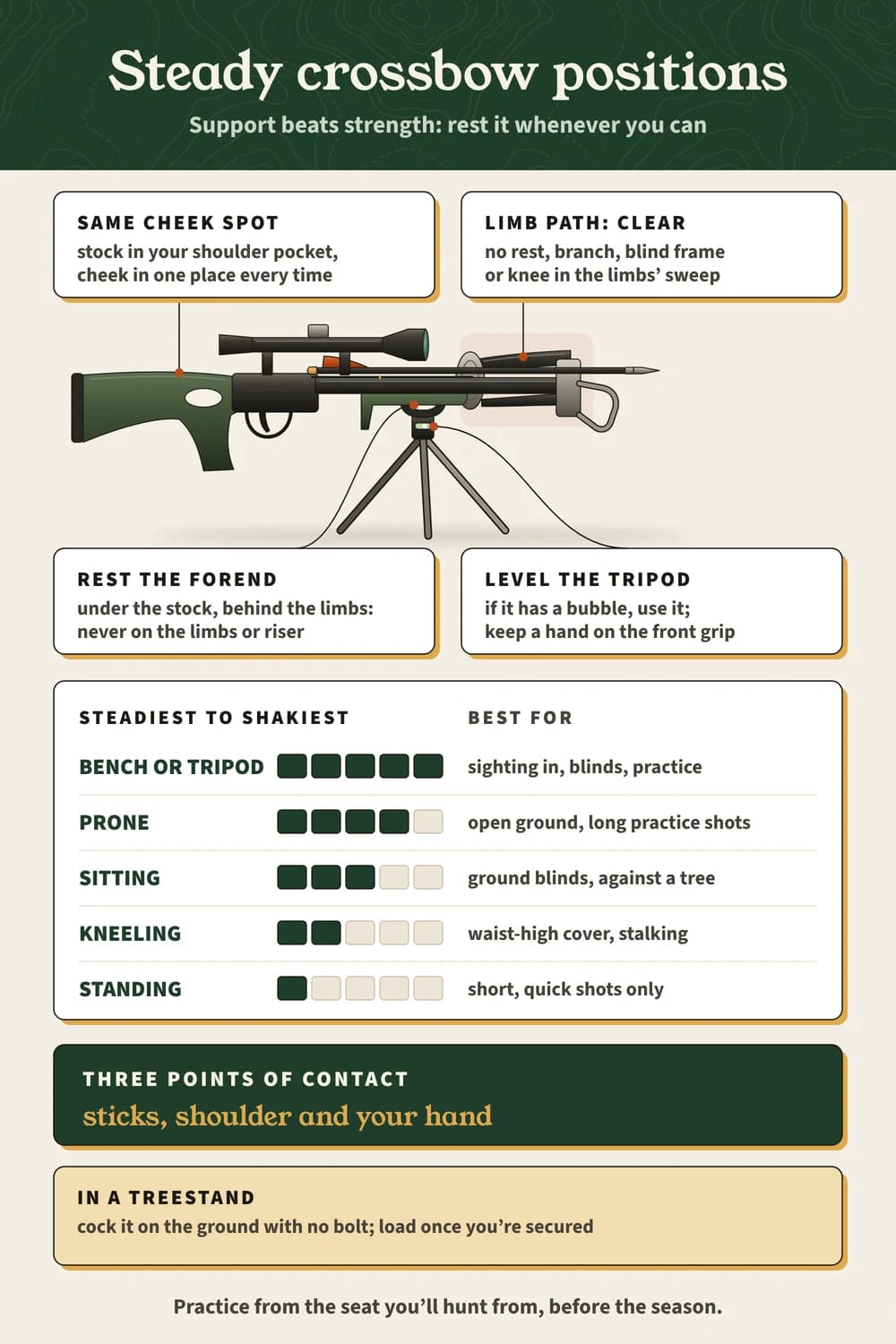
Before the questions, here's every position and the one rule that goes with all of them, on a single page.
// FAQ
Frequently asked questions
Quick answers to the questions readers ask most.
What is the most stable crossbow shooting position?
A bench or tripod rest, then prone. In the field, sitting with shooting sticks is the steadiest position most hunters can actually use.
Can you rest a crossbow on its limbs?
No. Rest it on the forend of the stock, behind the limbs; the limbs must be free to move when it fires.
Can you shoot a crossbow lying down?
Yes, if the limbs, cams and string have clear space above the ground. Raise the forend on a pack or bipod, and expect to stand or kneel to cock it again.
How do you shoot a crossbow from a treestand?
Rest it on the shooting rail with the limbs clear, and bend at the waist for steep shots. Cock it on the ground and load it only once you’re secured in the stand.
Are shooting sticks worth it for crossbow hunting?
Yes. Set them to the right height before a deer shows up, and use three points of contact: sticks, shoulder and your hand.
Final thoughts
The steadiest crossbow position is the one with the most support: bench or tripod, then prone, sitting, kneeling and, last, standing. Keep the limbs clear every time, and practice from the seat you’ll hunt from.
Track your groups from each position in the free range log, and you’ll know exactly which shots you can take this season.
