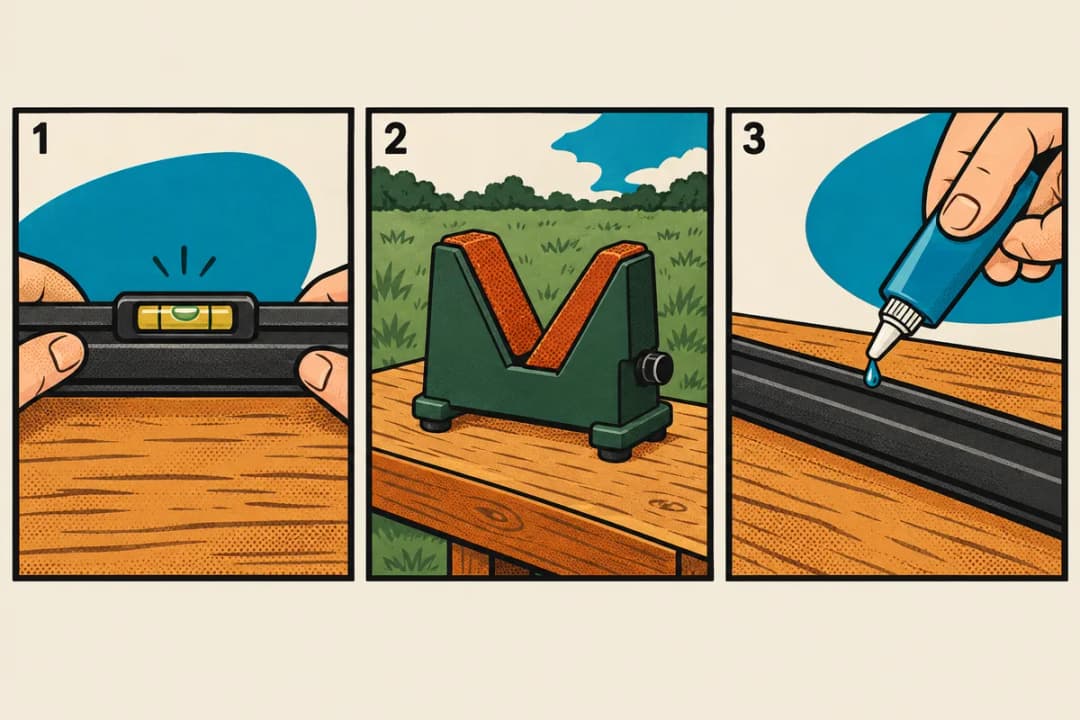


- Diagnose before you adjust: shoot numbered bolts in groups from a rest before you touch the scope.
- Most bad groups come from setup and shooter, not the crossbow: an off-center string, a canted bow, a jerked trigger.
- Mark the center of your string and cock with a rope or crank every time; a string 1/16″ off center can move a bolt several inches.
- Shoot one bolt model and one point weight, and cull any bolt that won’t hit with the rest.
- Still stuck? Take a measured group size to a shop, not “it doesn’t shoot well”.
Last fall it grouped fine. Now bolts spray left and right at 30 yards, and one keeps landing on its own. 😩
Hands off the scope dials for a minute. Find the cause with numbered bolts shot from a rest, then fix that one thing: most accuracy problems are a loose scope, an off-center string or a habit, not a bad crossbow. The fixes below start from what you see on the target.
Start with a diagnosis: the numbered-bolt test
A big group tells you something is wrong, not what. The numbered-bolt test separates bad bolts from a bad setup in one session.
Randy Wood of TenPoint Crossbows walks through the whole fix list in the video below. His first test needs only a marker:
You also want to number your arrows… Take arrow one and shoot it at dot one on the target, arrow two goes to dot two, three at three, so on and so forth.
It’s the best first step because it’s free and it answers the biggest question. If one number keeps landing away from its dot, the bolt is the problem; if they all wander, look at the crossbow and the shooter.
- Shoot from a solid rest at 20 yards, with field points.
- Number every bolt and give each its own aiming dot.
- Shoot three or four rounds, then compare where each number landed.
- Set aside any bolt that keeps missing its dot, and spin it on a flat surface to check for a wobble.

// Free printable
Get the range log I actually use.
Seventeen printable pages: session log, score tracker, a 30-day drill challenge, a bow maintenance card, a first-season checklist and more. Join the monthly email and it lands right away.
What your groups are telling you: a symptom chart
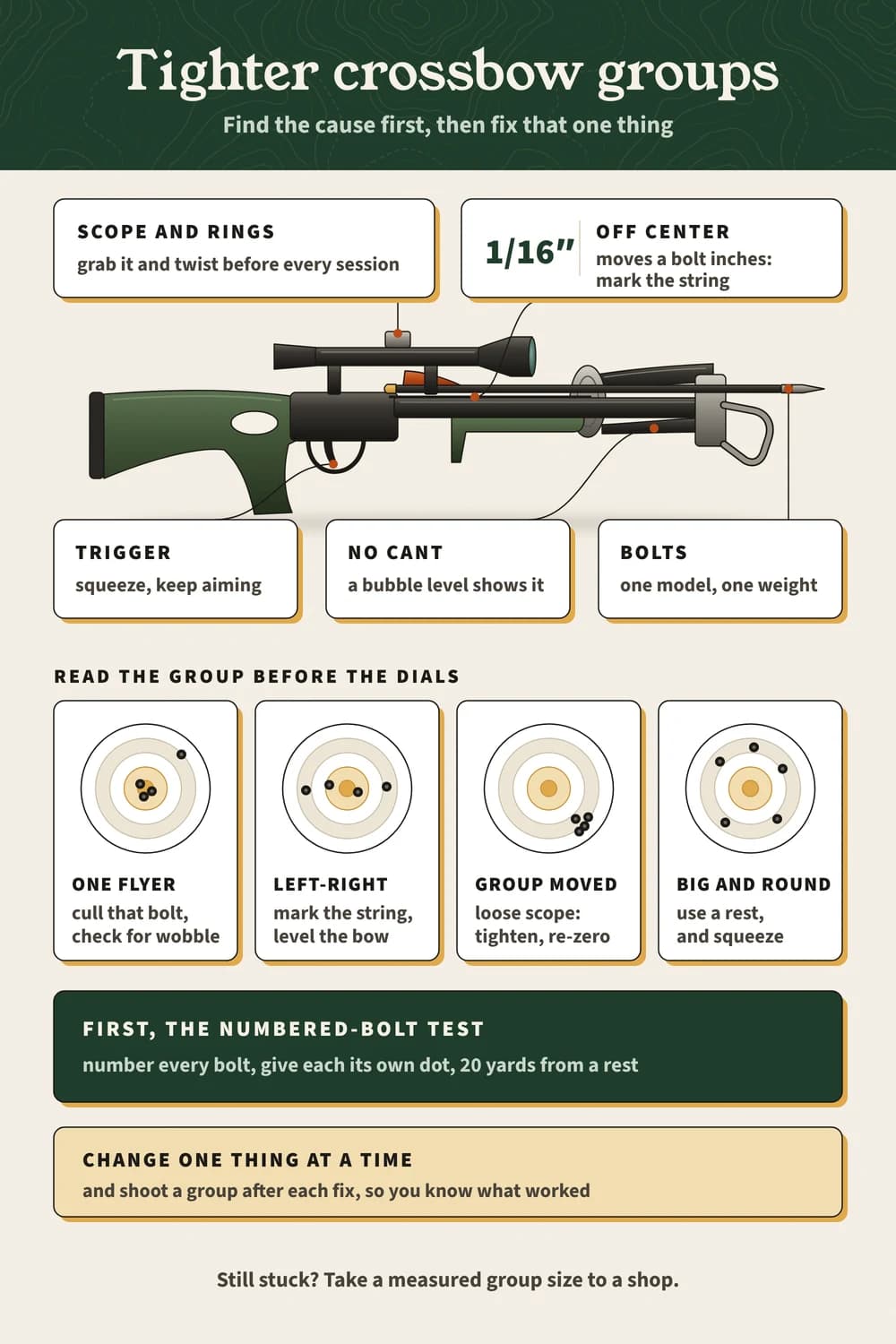
Read the target before you change anything. Each pattern points to a short list of causes:
| What you see | Most likely cause | Fix to try first |
|---|---|---|
| One bolt always off on its own | A damaged or different bolt, nock or vane | Cull it (fix 4) |
| Groups strung left and right | Off-center string or a canted crossbow | Mark the string, level the bow (fixes 2 and 5) |
| Whole group moved after a trip | Loose scope, rings or mount | Tighten and re-check the zero (fix 1) |
| High or low only at 40 yards and beyond | Speed-dial setting or wrong distance | Re-check the speed dial and range (fix 8) |
| Big, round group everywhere | No rest, a jerked trigger | Rest it and squeeze (fixes 6 and 7) |
| Broadheads land apart from field points | Broadhead flight | Re-check heads and bolts (fix 3) |
| Impact creeping over months; rub marks on bolts | String stretch, tiller or cam timing | Shop check (fixes 9 and 10) |
10 crossbow accuracy fixes, by cause
Work through them in this order: the first few are free and take minutes. Change one thing at a time and shoot a group after each, or you won’t know what worked.
1. A loose scope, ring or rail
Crossbows vibrate with every shot, and screws loosen over time and travel. Grab the scope and try to twist it; check the rings, the scope rail on the trigger box and, on a forward-draw bow, the front end where it meets the barrel.
2. An off-center string when you cock
When the crossbow is cocked, the serving should sit centered, with equal lengths on each side of the rail. A string 1/16″ off center can move impact several inches left or right, more at longer range, and hand-cocking makes it easy because one arm pulls harder.
The fix: with the string at rest, mark the serving with a marker on each side of the rail, cock with a rope cocker or crank every time, and check the marks line up before each shot.
3. Mixed bolts, points or broadheads
Different bolt weights and point weights hit different spots. Shoot the bolt length and weight your maker recommends, one model only, with field points and broadheads of the same grain weight; see the best bolt weight for hunting.
Broadheads that won’t hit with field points need fixing at the bolt and head, never by re-zeroing the scope. At modern crossbow speeds, smaller-diameter fixed heads usually fly more consistently than wide ones.
4. Damaged bolts, nocks or a misaligned odd vane
Check every bolt before you shoot it: cracked shafts, loose inserts, chipped nocks and torn vanes all throw shots. The odd-colored vane should line up with the notch in the nock, so the nock grips the string cleanly; the best crossbow bolts come with matched nocks.
5. A canted crossbow
Canting means tilting the crossbow so one limb sits lower than the other. If the left limb is lower, the bolt goes left, and it also hits high or low depending on the distance. Randy Wood puts it simply:
If you cant your crossbow and get a little bit side to side, then that will affect your downrange accuracy for sure.
He’s right. And it’s the hardest one to see from behind the scope. A bubble level on the scope or rail costs little and shows a cant instantly; level your tripod too if it has a bubble.
6. A jerked trigger and no follow-through
A crossbow trigger should be squeezed, not pulled. Press it slowly with the same spot on your finger, keep the crosshair on the spot and keep aiming untill the bolt hits.
7. Shooting without a rest
Crossbows are heavy to hold up and the crosshair wanders more the longer you aim. Use a bench to diagnose and shooting sticks or a stand’s rail in the field; the steadiest crossbow positions show how.
On a tripod, keep a firm hand on the front grip. Reverse-draw crossbows carry little weight up front and can jump on the shot, even in a rest.
8. Guessing the distance or the speed setting
A crossbow bolt drops fast past 30 yards, so a wrong distance means a wrong aiming point. Range your shooting lanes, use a rangefinder at the range and in the stand, and on a speed-dial scope check the dial is still set to your bolts’ real speed.
Not sure your scope is set up right in the first place? Go back to sighting in your crossbow scope, step by step.
9. A dry rail or a stretched string
A dry rail adds friction and wears the serving; a string that has stretched changes speed, so impact drifts. Lube the rail when it feels dry (see how to use rail lube), wax the string, and replace string and cables on your maker’s schedule.
10. A crossbow out of tune, or a bad scope
On a compound crossbow, the two cams should be mirror images; if one is rotated more than the other, the timing is off. Rub marks along a bolt or groups scattered left and right can mean the limbs are out of balance (tiller): both are shop jobs.
A scope can also fail. Randy Wood’s test is to mount a different scope and shoot a few bolts: if they suddenly group, the old scope was the problem. A scope built for crossbows, like Vortex’s Crossfire II, has a reticle and speed ring made for bolt drop:
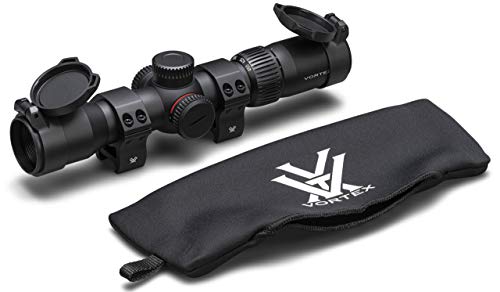
Vortex Crossfire II
Vortex Crossfire II 2-7x32 Second Focal Plane Crossbow Scope Kit | Red/Green Illumination, Fast-Focus Eyepiece, Includes Rings, Flip Caps, Neoprene Cover - Unlimited, Unconditional Warranty
by Vortex
Affiliate link: I may earn a commission, at no cost to you.
Key features
- 2–7× crossbow scope with holdover points from 20 to 100 yards
- Zoom ring doubles as the speed ring: set it to your bow’s real fps
- Its XBR-2 reticle zeroes at 40 yards, not the usual 20
- Red or green lit reticle; rings and battery in the box
Specs
- Brand
- Vortex
- Model
- CF2-CB1
- Size
- 30mm
- Color
- Black
- Length
- 14.09 inches
- Weight
- 0.875 Pounds
When to take your crossbow to a shop
If you’ve worked through the list and groups are still big, a crossbow service center or pro shop can check timing, tiller and the trigger. Go in with numbers, not a feeling.
Don’t just go in and say the bow doesn’t shoot well. Have some tangible, measurable thing. So what size is your group at 20 yards?
That’s the most useful advice in the video. Bring your bolts, your group sizes and the list of what you’ve already tried, so the shop starts where you stopped:
- Group size at 20 yards (and 30 or 40), from a rest.
- How many bolts per group, and which numbers were flyers.
- Your bolts and points, with their weights.
- What you changed and what happened.
Accuracy surprised me too when I started archery. Coming from firearms in the Marines, I expected it to be the easy part:
I guess what I thought would be easier was just accuracy.
It wasn’t, with my recurve, and it’s why I trust a checklist over a hunch. I’ve never shot a crossbow, so these fixes come from the makers and hunter education, but the lesson carries over: accuracy is many small things done the same way every time.
Print this one-page version and keep it in your range bag for the next time a group falls apart.
// FAQ
Frequently asked questions
Quick answers to the questions readers ask most.
Why is my crossbow shooting left or right?
Usually a string cocked off center or a canted crossbow. Mark the center of the serving and add a bubble level before you touch the windage dial.
Why does my crossbow hit high at 40 yards but fine at 20?
On a speed-dial scope, the dial is set slower than your bolts fly; turn it up. Also check the distance with a rangefinder, since a guessed 40 is often 35.
Do heavier bolts make a crossbow more accurate?
Not by themselves. Consistent bolts at your maker’s recommended weight group best; changing weight just moves the impact.
How far can a beginner shoot a crossbow accurately?
Only as far as you can group consistently from your hunting position. Test it at the range and use the ethical shot checker before you hunt.
How often should I check my crossbow scope screws?
Before every range session and every hunt, and after any trip. A quick twist test takes seconds.
Final thoughts
Better crossbow accuracy comes from finding the cause, not chasing it with the scope: numbered bolts from a rest, then fix the one thing the target points to. Start with the free fixes (tight scope, centered string, level crossbow) and work down.
Write your group sizes and each fix in the free range log, so you have the numbers if you ever need a shop.
